The proper selection of cable for powering garden lighting is the foundation of a safe and reliable installation. At Onninen, we advise installers daily on technical issues related to the implementation of outdoor electrical installations. Our years of experience show that the cable for garden lamps must meet specific requirements regarding resistance to weather conditions and user safety.
Powering garden lighting differs significantly from indoor installations. The cables must be adapted to work in harsh conditions - from moisture and frost to exposure to UV radiation and mechanical damage during gardening work. In our offer, you will find cables and wires dedicated to outdoor applications that guarantee long-lasting and trouble-free operation.
The choice of the appropriate cable primarily depends on the supply voltage and the method of conducting the installation. Installers can choose between low-voltage solutions (12V/24V) and classic 230V network installations, with each option requiring the use of appropriate electrical installation materials.
Check cables and wires at Onninen warehouse
Low-voltage installations 12V/24V – simplicity and safety
Low-voltage systems are an excellent choice for smaller gardens and installations with limited power. At Onninen, we recommend this solution especially for path lighting, highlighting vegetation, or decorative garden elements. The voltage of 12V or 24V significantly increases user safety, especially in areas exposed to contact with water.
Characteristics of low-voltage installations
- Maximum range: 25-30 meters from the transformer
- Depth of cable laying: 20-30 cm below the ground surface
- Total lamp power limited by the transformer power
- Possibility to use any wire of appropriate cross-section
- Increased safety in areas exposed to flooding
In low-voltage installations, multi-core cables with a cross-section of 1-1.5 mm² are most commonly used. However, as our experts emphasize - the larger the cross-section, the lower the resistance of the wire, which translates into lower energy losses and better efficiency of the entire installation.
Advantages of low-voltage solutions
From our experience, installers appreciate the simplicity of mounting 12V/24V systems. Cables can be laid at any depth in the ground, but to protect against damage during gardening work, we recommend placing them in a corrugated protective tube at a depth of about 30 cm.
Network installations 230V – power and versatility
When planning an extensive garden installation with multiple light points, powerful spotlights, or facade lighting, it is essential to use the 230V network voltage. In Onninen's assortment, you will find YKY cables with insulation voltage resistance up to 1 kV - this is the standard for such applications.
Requirements for 230V installations
| Parameter | Requirement |
|---|---|
| Cable type | YKY (underground cable) |
| Cross-section of conductors | Min. 1.5 mm², recommended 2.5 mm² |
| Depth of laying | Min. 70 cm (in non-competitive zones even up to 1.4 m) |
| Mechanical protection | Protective tubes made of plastic |
| Distance from the water supply network | Min. 80 cm |
Specification of YKY cables in Onninen's offer
Our YKY cables are designed for direct laying in the ground and feature reinforced insulation resistant to UV radiation. We offer the following variants:
- YKY 3x1.5 mm² - basic model for small installations
- YKY 3x2.5 mm² - universal solution for most applications
- YKY 5x2.5 mm² - allows independent control of three circuits
- YKYp 3x2.5 mm² - reinforced protective coating for harsher conditions
Practical aspects of installation and protection
In our practice, we often encounter questions regarding the proper conduct of garden installations. It is crucial not only to select the appropriate cable but also to ensure its proper protection and routing of cable paths.
Rules for routing cable paths
When designing a garden installation, we always adhere to several basic rules. Cables are routed in straight lines, avoiding unnecessary bends. In places where direction changes are necessary, we use right angles, not curves. We pay special attention to the distance from the building's foundations - high-voltage cables should not run in their immediate vicinity.
Protection against external factors
Our experience shows that garden cables are exposed to chemicals used in gardening. Therefore, we avoid routing installations in areas of intensive use of fertilizers, pesticides, or plant care products. In Onninen's assortment, there are cables with additional protective coatings that increase resistance to such threats.
Ring power supply systems
For installations with multiple light points, we recommend using a ring power supply. The power cable is laid in a loop coming from the power point and returning to it. This way, the lamps are powered from both sides, which increases reliability - in case of damage to one section, the remaining light points continue to function.
Selection of cross-section and cable load capacity
Properly selecting the cross-section of conductors is a key element in designing a garden installation. At Onninen, we offer wires with cross-sections from 1.0 mm² to 10 mm², allowing for optimal adjustment to the requirements of each project.
Criteria for selecting cross-section
The cross-section of the cable is selected based on several key parameters. The most important are the total power of connected lamps, the length of the installation, and the allowable voltage drop. Our calculations show that 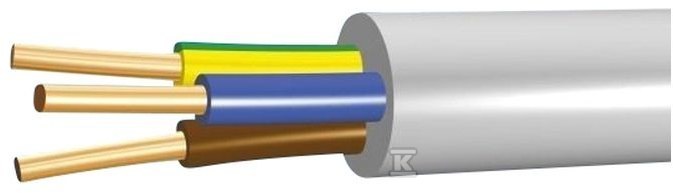 for a typical garden installation with a power of 500W and a length of 30 meters, the optimal cable is one with a cross-section of 1.5 mm². For greater distances or higher powers, we recommend a cross-section of 2.5 mm².
Maximum loads in practice
- Cross-section 1.5 mm² - up to 16A (about 3.7 kW at 230V)
- Cross-section 2.5 mm² - up to 25A (about 5.7 kW at 230V)
- Maximum 20 garden lamps on one circuit
Frequently asked questions
1. What depth should I dig for cables for garden lamps?
The depth depends on the voltage of the installation. For low-voltage installations 12V/24V, 20-30 cm below the ground surface is sufficient. We lay 230V cables at a depth of at least 70 cm, and in frost zones even up to 1.4 m with appropriate protective tubes.
2. Can I use regular YDY wires for garden installations?
No, YDY wires are not intended for laying in the ground. For garden installations, YKY cables should be used, which have appropriate insulation resistant to moisture, frost, and UV radiation. At Onninen, we offer a full range of underground cables that meet PN-EN 50525 standards.
3. How many garden lamps can I connect to one circuit?
A maximum of 20 garden lamps on one circuit. The limitation arises from safety requirements and practical aspects of operation. In case of a failure, it is easier to locate the fault, and the load on the installation remains within safe limits.
4. What distance should be maintained from water pipes?
A minimum distance of 80 cm from the water supply network. This solution ensures the safety of the installation and facilitates possible repairs in the future. If installation under water tanks is necessary, the cables must have a high degree of protection IP.
5. When should I choose a 12V/24V installation, and when 230V?
12V/24V installations are a choice for small gardens with a few lamps. When planning an extensive installation, powerful spotlights, or facade lighting, the 230V network voltage is necessary. Low-voltage systems are limited by the power of the transformer and a range of 25-30 meters.
6. Do garden cables require additional protections?
Yes, 230V cables require protection in installation tubes. Additionally, above the cable at a depth of 30 cm, we place a blue warning tape. Garden installations must be protected by a residual current device and an overload protection device matched to the load power.
Modern solutions in Onninen's offer
As a leader in the installation market in Poland, we offer not only traditional solutions but also modern technologies for garden lighting. In our assortment, you will find garden lighting of the latest generation and dedicated control systems.
We pay special attention to BiT 1000® solar cables, which perform well in photovoltaic installations and hybrid lighting systems. They are resistant to UV radiation, high temperatures, and extreme weather conditions - making them an ideal complement to modern garden installations.
Our branches throughout Poland provide quick access to a full range of cables and wires. The Onninen team of experts offers professional advice at every stage of the project - from material selection to technical support during installation. With over 100 years of experience in the installation industry, we offer solutions proven by thousands of implementations.