Choosing the right heating device is a decision that directly affects thermal comfort and operating costs. At Onninen, as a leader in the installation market, we help customers every day make the right choice between radiators and heaters. Our many years of experience show that this decision primarily depends on the specifics of the room and the planned method of use.
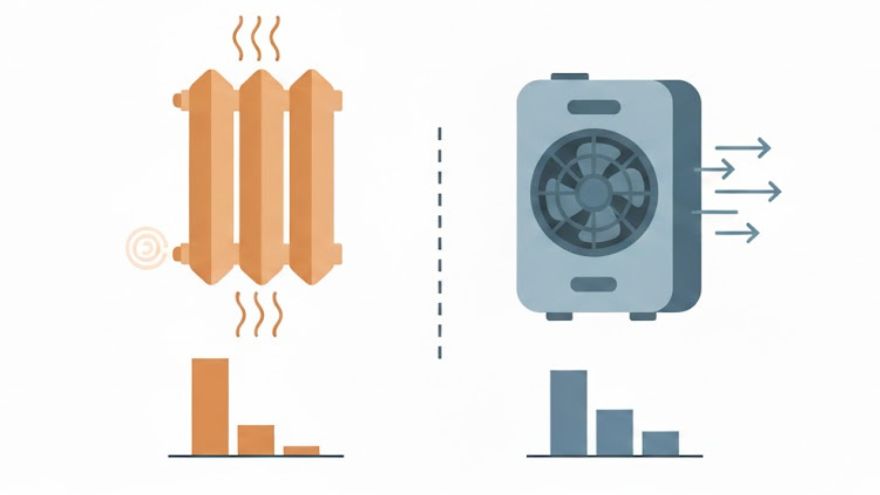
Radiators and heaters represent two different heating philosophies, each with its own advantages and limitations. Radiators mainly operate through natural convection and radiation, providing constant, even heat. Heaters use forced air circulation, offering rapid temperature increases but require electrical energy for the fan.
Check radiators at Onninen warehouse
Operating principles and structural differences
The fundamental differences between radiators and heaters lie in the way heat is transferred. Traditional radiators use the surface of the heat exchanger to emit heat through radiation and natural convection. In Onninen's assortment, we offer a wide range of steel, aluminum, and bimetal radiators that ensure long-lasting and efficient operation.
Characteristics of traditional radiators
- Temperature stability: even heat emission for a long time
- Quiet operation: no mechanical components
- Durability: lifespan of 25-30 years with proper maintenance
- Low operating costs: no additional electricity consumption
Operating principle of heaters
Water heaters combine a heat exchanger with a fan that forces air circulation. This design allows for rapid temperature increases in the room but comes with additional electricity consumption. The power of the heater depends not only on the parameters of the heating medium but also on the fan's rotational speed.
Energy efficiency and operating costs
An analysis of investment and operating costs clearly indicates the superiority of one solution under specific conditions. From the experience of our specialists at Onninen, it appears that radiators are more economical in long-term operation, especially in buildings with good thermal insulation.
| Comparison aspect | Traditional radiators | Water heaters |
|---|---|---|
| Purchase costs | Higher (2-3x more devices) | Lower (fewer units) |
| Installation costs | Higher (more connection points) | Lower (electrical installation) |
| Operation | Only heat from the central heating system. | + electricity consumption |
| Heating time | 40-100 minutes to comfort | 15-40 minutes to comfort |
Power selection - key differences
When selecting radiators, the power depends solely on the dimensions of the device and the supply temperature. In the case of heaters, the situation is more complex - the catalog power is given for the maximum fan speed, which can be misleading in practice. The actual working power of the heater often ranges from 50-70% of the nominal power.
Applications in different types of rooms
When to choose traditional radiators
Our many years of experience indicate that radiators perform excellently in residential rooms, offices with standard heights (up to 3.5 m), and anywhere where quiet operation and stable temperature are priorities. In Onninen's offer, you will also find modern electric radiators for supplementary applications.
- Apartments and houses: living room, bedrooms, children's rooms
- Offices: offices, conference rooms, open spaces up to 3.5m high
- Healthcare facilities: where quiet operation is required
- Dusty facilities: production halls, warehouses with dust
Optimal applications of heaters
Water heaters find their application in facilities with specific requirements. We particularly recommend them in situations where rapid temperature increases or effective heating of high rooms is needed.
- High rooms: halls above 4m, where warm air accumulates under the ceiling
- Transitional spaces: easy access, exhibition halls
- Facilities with limited wall space: installation under the ceiling
- Applications requiring rapid heating: workshops, garages
Use of electric heaters
In Onninen's assortment, we also offer electric heaters, which are suitable as temporary or supplementary solutions. These devices are characterized by mobility and immediate operation but generate higher operating costs.
Installation and installation requirements
The differences in installation between radiators and heaters significantly affect the costs of the entire investment. Radiators require a greater number of connection points to the water installation, which increases expenditures on piping and fittings. Water heaters additionally require 230V electrical power for the fan.
Requirements for radiators
- Connection to the central heating system (supply/return)
- Installation of thermostatic and air vent valves
- A greater number of connection points in the installation
- Mounting to the wall or floor
Specifics of heater installation
- Water connection (similar to radiators)
- Additional 230V electrical power supply
- Installation usually under the ceiling
- Need to ensure air flow
Frequently asked questions
1. Are heaters more economical than radiators?
Heaters are cheaper to purchase but more expensive to operate. They require additional electrical energy for the fan (50-200W), while radiators only consume heat from the central heating system. Over a 3-year period, the operating costs of radiators can be 2-3 times lower.
2. Which solution heats the room faster?
Water heaters reach a comfortable temperature in 15-40 minutes. Radiators need 40-100 minutes but provide more stable and long-lasting heat. The speed of heating of heaters results from the forced air circulation by the fan.
3. In which rooms are radiators better?
Radiators perform excellently in apartments, offices, and facilities up to 3.5m high. They are particularly recommended for bedrooms, living rooms, and spaces where quiet operation is important. In dusty rooms, radiators are the only reasonable choice.
4. When is it worth choosing water heaters?
Heaters are optimal in high rooms above 4 meters. They perform well in halls, workshops, garages, and anywhere where rapid temperature increases are needed. Installation under the ceiling saves usable space.
5. What is the lifespan of radiators and heaters?
Radiators last 25-30 years, heaters 15-20 years. The difference arises from the presence of mechanical parts in heaters - the fan requires periodic bearing and motor replacement. Radiators have no moving parts, which translates into greater reliability.
6. Are heaters noisy in operation?
Heaters generate noise levels of 35-45 dB due to the operating fan. In residential and office spaces, this can be bothersome. Radiators operate completely silently, which is a significant advantage in spaces requiring quiet.
7. How much does the installation of radiators cost compared to heaters?
The installation of radiators is 2-3 times more expensive than that of heaters. This is due to the greater number of connection points - one radiator requires about 100 PLN for labor, while a heater about 900 PLN, but replaces several radiators. Heaters also require additional 230V electrical power supply.
Professional advice in choosing the optimal solution
The decision between radiators and heaters should not be made hastily. At Onninen, we offer comprehensive technical advice that takes into account the specifics of the facility, user requirements, and the available investment budget. Our many years of experience in the installation industry allows for optimal selection of solutions for every type of building.
As a leader in the installation market, we provide access to the latest technologies in heating. In Onninen's assortment, you will find both traditional steel and aluminum radiators, as well as modern water heaters and electric radiators for specialized applications.
Our specialists in branches throughout Poland provide professional advice and assistance in selecting optimal device parameters. Thanks to a wide distribution network, all products are available immediately, which shortens the time for the implementation of installation projects. By investing in solutions from Onninen's offer, you gain assurance of quality, reliability, and long-lasting operation of heating systems.