The problem of hard water affects most households in Poland, where the average hardness of tap water significantly exceeds the recommended level of 10 German degrees by WHO. At Onninen, we have been supporting installers for years in selecting optimal solutions for water softening, offering proven water treatment systems from renowned manufacturers.
Our long-term cooperation with professionals in the installation industry has allowed us to gather practical knowledge about which water softeners perform best in various applications. In this article, we present a comprehensive overview of the best solutions, taking into account both technical aspects and practical user experiences.
Choosing the right water softener is an investment in the long-term protection of the heating system, extending the lifespan of household appliances, and ensuring comfort in daily water use throughout the home. Thanks to our experience, we will help you make an informed decision.
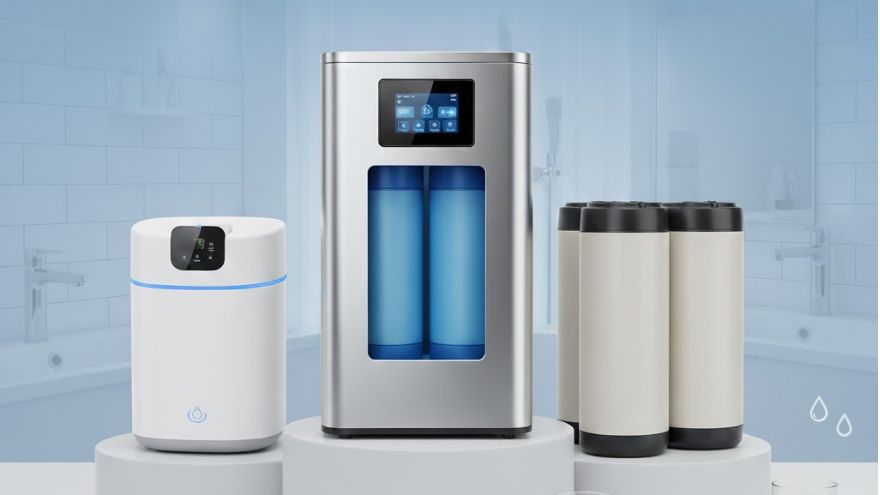
Check water softeners at Onninen wholesale
Why is water hardness a problem for installations
Hard water contains excessive amounts of calcium and magnesium ions, which form scale deposits when the water is heated. These deposits have a destructive effect on the entire water and heating installation. Just 1 mm of scale can reduce the efficiency of the heating system by 10%, increasing energy consumption by about 20%.
Consequences of hard water for installations
- Scaling in boilers, radiators, and pipes
- Reduced capacity of water installations
- Accelerated wear of household appliances (washing machines, dishwashers, coffee machines)
- Increased consumption of detergents and cleaning agents
- Higher heating bills
- More frequent breakdowns and the need to replace installation components
In our commercial practice, we observe that installers most often recommend central water softening systems as the most effective solution to the problem of hard water throughout the building.
How to choose the best softener for your needs
Selecting the optimal water softener requires considering several key technical parameters. From our experience in servicing installation customers, the most important criteria are:
Key technical parameters
| Parameter | For 2-3 people | For 4-5 people | For 6+ people |
|---|---|---|---|
| Resin capacity | 12-15 liters | 20-25 liters | 30+ liters |
| Maximum flow rate | 1-2 m³/h | 2-3 m³/h | 3-4 m³/h |
| Monthly water consumption | 6-9 m³ | 8-12 m³ | 15+ m³ |
| Salt consumption | 8-12 kg/year | 15-25 kg/year | 30+ kg/year |
Types of controllers and additional functions
In Onninen's assortment, you will find softeners with various types of controllers – from basic models with time regeneration to advanced systems with electronic volumetric control. The latter are much more economical, as they only initiate regeneration after the actual consumption of a specified amount of water.
Modern models also offer features such as a salt level indicator, anti-flood protection, a by-pass valve, and controllers with an LCD display in Polish – all of which enhance user convenience.
The best water softeners in Onninen's offer
Based on years of experience and customer feedback, we present a compilation of the best softeners available in our offer. All presented models are characterized by high quality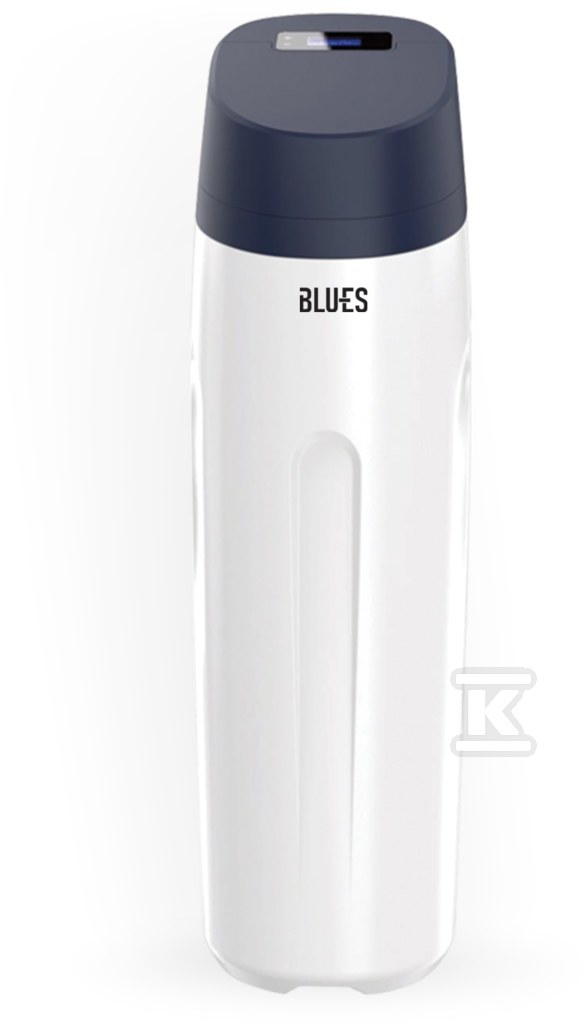 of workmanship, reliability, and affordable operating costs.
USTM BLU ES - compact and functional
The model USTM BLU ES 25l is an excellent choice for medium-sized households. Equipped with an LCD electronic controller and a by-pass function, it ensures convenient operation and reliable performance.
Key advantages of the BLU ES model:
- Resin capacity of 25 liters – ideal for 4-5 person families
- Electronic control with an LCD display
- By-pass valve as standard
- Rinsing hose included
- Compact dimensions facilitating installation
ONNLINE - advanced control technology
The ONNLINE with electronic volumetric control series represents a modern approach to water softening. The 20-liter model is suitable for smaller homes, offering advanced control functions.
Characteristics of the ONNLINE series:
- Electronic volumetric control – maximum savings
- Regeneration triggered only by actual demand
- Intuitive control panel
- High-quality components ensuring long lifespan
- Optimal salt consumption
Professional systems for larger facilities
For installers working on projects in larger buildings, we recommend complete water treatment systems with the possibility of expanding with additional filtration modules.
In our offer, you will also find dual-buffer systems, ideal for facilities with high water demand, where the continuity of softened water supply is crucial for the proper functioning of the installation.
Practical aspects of operating softeners
Operating modern softeners is relatively simple, but knowing the basic maintenance principles allows for maintaining optimal operating parameters for many years.
Operating costs and savings
For a typical 4-5 person household, the monthly operating costs of a softener 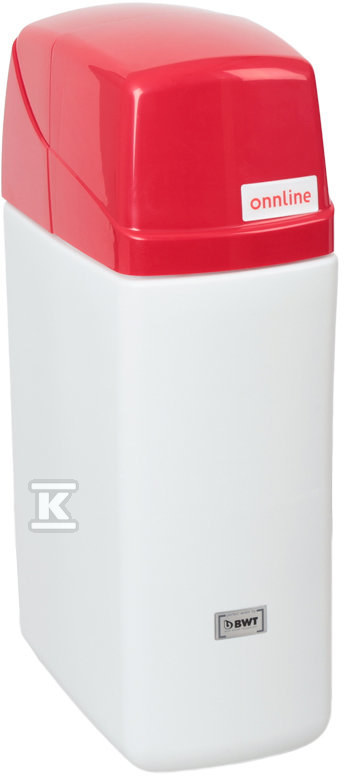 amount to about 15-20 zlotys, including electricity consumption, water for regeneration, and tablet salt. These costs are significantly lower than potential losses associated with damage to installations and household appliances due to hard water.
Regeneration of the resin – a key process
The regeneration process of the ion-exchange resin occurs automatically, usually at night. It involves flushing the resin with a salt solution, restoring its ion-exchange capacity. The frequency of regeneration depends on the hardness of the water and its consumption – modern controllers optimize this process, minimizing water and salt consumption.
In practice, this means that with a properly selected softener, regeneration occurs every few or several days, and the user only needs to monitor the salt level in the tank and replenish it as needed.
Frequently asked questions
1. Is softened water safe to drink?
Yes, softened water can be consumed without concern. The softening process merely exchanges calcium and magnesium ions for sodium ions. The amount of sodium added is minimal - about 8.2 mg of sodium per liter of water for each German degree of hardness. People on a salt-free diet should take this into account when calculating their daily salt intake.
2. How much does it cost to operate a water softener?
Monthly operating costs are about 15-20 zlotys for a typical family. This includes: electricity consumption (about 3-5 zlotys), water for regeneration (2-4 zlotys), and tablet salt (8-12 zlotys). A 25 kg bag of salt lasts for 3-4 months of operation, making it very economical.
3. What size softener should I choose for a family of 4?
For a family of 4, we recommend a softener with a resin capacity of 20-25 liters. This capacity will ensure optimal operating parameters with a monthly water consumption of 8-12 m³. A too-small softener will regenerate more frequently, increasing operating costs.
4. Does the softener require connection to the sewage system?
Yes, connection to the sewage discharge is absolutely necessary. During resin regeneration, the used brine containing calcium and magnesium ions must be discharged into the sewage system. Without this connection, the softener cannot function properly.
5. How often should salt be replenished in the softener?
Salt should be replenished every 2-4 months, depending on the hardness of the water and its consumption. Modern controllers signal low salt levels, and the tank should always be filled to about 2/3. Only tablet salt designed for softeners should be used.
6. Can the softener be installed by oneself?
The installation of the softener should be performed by a qualified installer. It requires connection to the water, sewage, and electrical installations. Improper installation can lead to device failure or damage to the installation. Professional installation also guarantees the preservation of warranty conditions.
7. How long does the resin in the softener last?
High-quality ion-exchange resin lasts about 15-20 years with proper operation. The lifespan of the resin depends on the quality of the raw water, the frequency of regeneration, and the quality of the salt used. Regular maintenance and using appropriate operating materials significantly extend the service life.
8. Does the softener protect against bacteria in the water?
The softener is not a bactericidal device, but it prevents the growth of some bacteria. By removing scale, it eliminates the environment in which harmful bacteria like Legionella can multiply. Dedicated UV or ozonation systems are needed for water disinfection.
Investing in water quality - long-term benefits
Choosing the right water softener is a strategic decision that affects the functioning of the entire water and heating installation in the building. At Onninen, we understand that our customers - professional installers - need reliable solutions that will ensure user satisfaction for many years.
Our years of experience in distributing water treatment systems show that investing in a high-quality water softener pays off within the first year of operation due to savings on heating costs, longer lifespan of household appliances, and reduced detergent consumption.
We encourage you to contact our specialists who will help you choose the optimal solution for each project. In the Onninen branch network across Poland, comprehensive water treatment systems are also available along with professional technical advice and training for installers.