Using hot water seems obvious to many people, but not everyone has access to hot water from the city network. In such a case, you can choose a boiler or a water heater. Today we will present you the advantages and disadvantages of each solution. You will also learn which device is more economical.
Advantages and disadvantages of a boiler
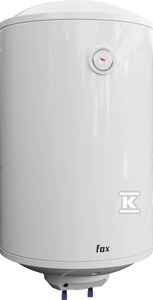 An electric boiler is a capacitive water heater. This is a device that is used to heat utility water. It is important to know that it is easy to install and operate. There are various models available, e.g. with a capacity of 50 liters or 80 liters. Such boilers can be equipped with one or several electric heaters. It is also important to remember that low-power heaters consume significantly less energy, but they take longer to heat up. On the other hand, higher-power boilers will heat up faster, but they will increase the cost of using electricity. When choosing, you should definitely pay attention to the power. For example, a model with a power of 3 to 4.5 kW will work well for a single-family house. The size is also important. The capacity of the tank should be selected according to the number of people living in the house. For a family of several people, a 120-liter boiler will work well.
A useful function is the ability to regulate the water temperature. The control system provides greater convenience. You can't forget about heat transfer. This parameter determines how quickly the device cools down after the power is turned off. In the case of capacity water heaters, you need to know that the water is heated when it is used. It's time to learn about other advantages. This includes quiet operation.
Advantages of using a boiler:
- ease of assembly;
- safety of use;
- ease of use;
- works well even for a large family;
- quiet operation;
- ability to regulate water temperature;
- The water cools down slowly thanks to the durable housing.
Boiler Disadvantages:
- may take a long time to heat up;
- a more powerful device increases electricity costs;
- a large device takes up a lot of space;
- when you unplug the device and use up all the water in the boiler, after plugging it back in you have to wait quite a long time for the water to heat up;
- Many appliances require descaling.
Check out the boilers at the Onninen wholesaler
Advantages and disadvantages of a water heater
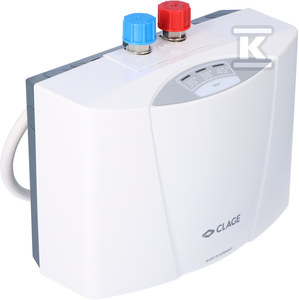 An alternative to a storage boiler is an electric instantaneous water heater . The operating principle is very simple. In this case, the signal to start heating the water will be to turn on the tap. So we have hot water whenever we need it. You can choose between single-point and multi-point heaters. The former heat water to one tap. They usually have a power of 3.5 kW to 6 kW, while multi-point heaters heat water to several places and have a power of 12 to 24 kW. Remember that in order to minimize heat loss, it is best to install heaters as close to the tap as possible. Undoubtedly, the greatest advantage of this type of device is high comfort of use. The instantaneous heater does not take up much space. It can be placed, for example, in the kitchen above the sink. It will work well even in a small apartment and will not disturb the cubic capacity of the room. We must also mention that by choosing a multi-point heater, several people can use hot water at the same time. Of course, the instantaneous water heater is not without its drawbacks. You must ensure a minimum water flow. For proper operation, the pressure in the installation must be high. In addition, these devices can consume quite a lot of electricity.
Advantages of a flow heater:
- convenience of use without the need for daily maintenance;
- reducing energy losses;
- doesn't take up much space;
- easy assembly;
- In the case of multi-point devices, several people can use hot water at the same time.
Disadvantages of a flow heater:
- high energy consumption;
- the need to ensure adequate water flow;
- the need to ensure high water pressure in the installation;
- In many devices, when you turn on the tap, cold water flows first, which increases water consumption.
Check out the water heaters at the Onninen wholesaler
What is more profitable, a boiler or a heater?
It can be said that both the boiler and the instantaneous water heater are functional solutions. It is certainly worth noting that the water is heated and then stored in the boiler. Rapid cooling of the water is prevented by the special insulation of the boiler, as well as the thermostatically controlled heater. This means that when you turn on the tap, the warm water is pushed out of the boiler by the cold water. This happens as a result of pressure. After using up the stored water, you have to wait for it to heat up again. Considering this parameter, the instantaneous water heater has an advantage over the boiler, because it heats the water continuously. Therefore, energy consumption begins the moment the user turns on the hot water tap. You also need to know that energy is consumed until the tap is turned off, although it sometimes happens that cold water flows first, and only after a few moments, warm water.
Of course, the question arises here - which solution is more energy-efficient? Basically, the answer is not clear-cut, because it depends to a large extent on the number of taps, the number of residents, their habits, but also the size of the house or apartment itself. If we take into account that the demand for water is large, then a boiler is more cost-effective, while a flow heater will work better when there are a small number of water collection points. This solution also works when users do not use a large amount of water.