Current knowledge in the field of ergonomics leaves no doubt that lighting at workstations has a significant impact on employee efficiency. Proper lighting at the workstation protects the eyes from premature fatigue, supports concentration and improves well-being, which naturally increases productivity. In turn, improper light intensity and inappropriate color can cause eye strain, loss of energy, irritation and difficulty in focusing on tasks. Learn how light intensity and color shape efficiency.
Check out LED interior lighting at the Onninen wholesaler
How does the type of artificial light affect work efficiency?
Natural light (sunlight, daylight) is the most beneficial for the human body. However, not all interiors can provide sufficient natural light - especially in the winter months. Daylight deficiencies are compensated by artificial lighting. It is an essential element of equipment in virtually every work area, whether a professional office or a home office. Choosing the right lighting fixtures and light sources has a huge impact on the quality of work and the health of employees. Workstations are increasingly illuminated by modern LED interior lighting , replacing traditional fluorescent lamps. LED technology provides eye-friendly light with 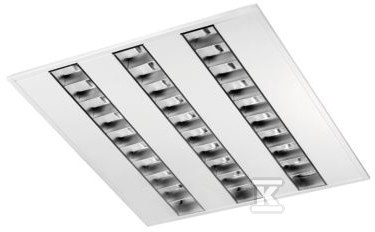 precisely matched to the needs of the parameters. It guarantees low electricity consumption, long service life and efficient operation throughout the entire period of use.
It is important to equip an office space with both general lighting (ceiling, top, central) and spot lighting (directional, functional). The former is responsible for evenly dispersing light throughout the room, while the latter allows the employee to individually manage lighting at a given workstation, so that work is as comfortable as possible. Each employee should be able to adjust the color and intensity of light to their own preferences.
The way in which the lighting fixtures are arranged in the office is also important. Shadows and reflections should be avoided, as they interfere with work.
What should the light intensity be for best efficiency?
Light intensity is a factor that significantly affects comfort, safety and work efficiency. A suitably intense glow prevents premature eye fatigue, facilitates concentration and supports error-free performance of tasks. According to the PN-EN 12464-1:2004 standard, lighting at computer stations should have a minimum of 500 lx (lux). 300 lx is required for the entire office. If an employee performs very precise activities, e.g. jewelry processing, the optimal light intensity for them will be at a level of even 1000 lx .
The influence of light color on work efficiency

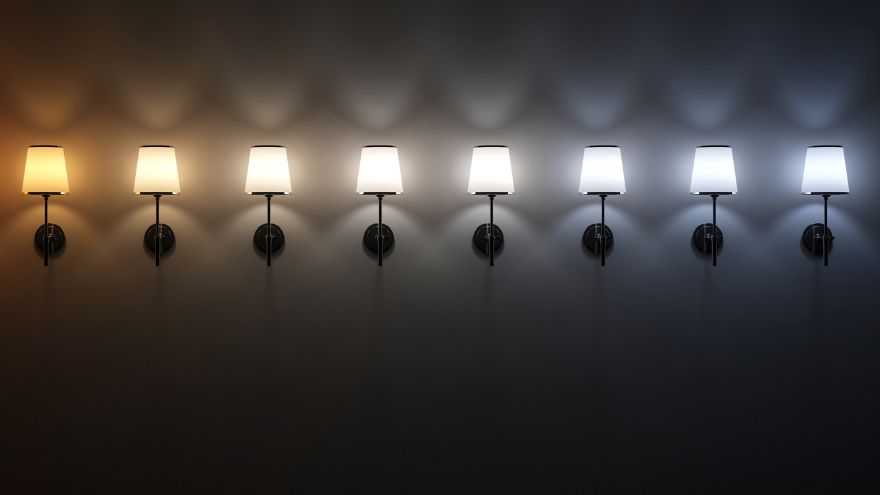
The color of light affects well-being, the ability to concentrate, and the way an employee sees the colors of illuminated objects. That is why the correct selection of color is so important for work efficiency. LED lighting can emit a glow with a warm, neutral, or cold color temperature. This parameter is given in Kelvin (K).
· Warm light (around 2700-3300 K) creates a cozy, relaxing atmosphere, so it is not usually used in offices. The exceptions are rooms designed strictly for quiet and relaxation.
· Neutral light (around 4000-5000 K) is the most versatile because it resembles daylight. This is the color temperature that general lighting in offices usually has.
· Cold light (around 5000-6500 K) is used directly at workstations because it improves concentration, adds energy and makes it easier to perform precise activities.
When choosing indoor lighting fixtures , it is also worth paying attention to the color rendering index (CRI). The higher the CRI value, the more faithful the color reproduction.
Looking for LED lamps for professional use? See LED lighting available at the Onninen electrical wholesaler. Our range includes thousands of lighting fixtures, light sources, lighting poles and accessories.