An effective drainage system is of great importance in any construction investment. A properly selected drainage pipe in a casing has several important tasks: it protects the structure from moisture, improves soil stability, and simultaneously prevents the area from becoming waterlogged. Let's take a look at the most important issues by answering the following questions - how much does a drainage pipe in a casing cost, what factors determine its price, and when is investing in such a solution most cost-effective?
Check drainage pipes at Onninen warehouse
What is a drainage pipe in a casing and what is it used for?
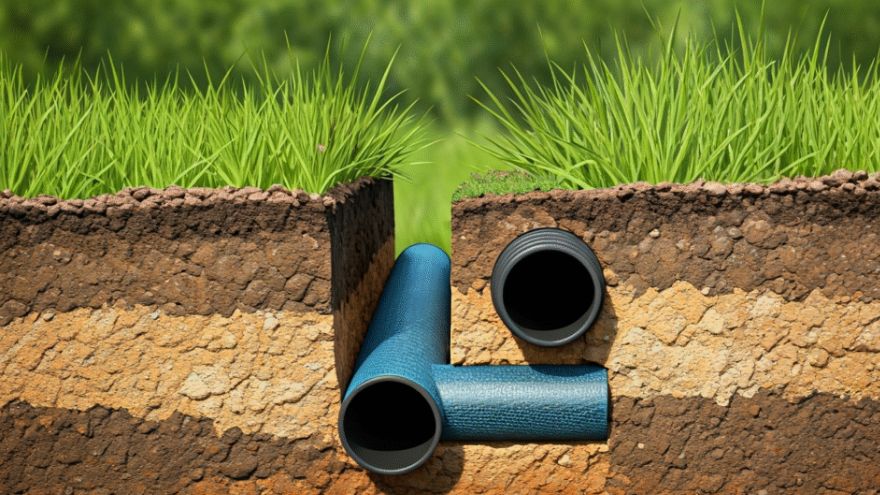
A drainage pipe in a casing is a flexible conduit, usually made of polyethylene (PE) or PVC. Its main task is to drain excess water from the soil, which is why it is used in drainage systems for buildings, fields, gardens, yards, and roads.
The casing, for example made of geotextile or coconut, acts as a filter that has several extremely important tasks, including preventing the perforations of the pipe from clogging with soil particles. It simultaneously extends the lifespan of the entire drainage system and increases the efficiency of water drainage in difficult soil conditions.
There are several applications for drainage pipes in casings.
These primarily include:
- drainage around building foundations and basements,
- melioration and agricultural systems,
- drainage for driveways, parking lots, and paved surfaces,
- protection of slopes, embankments, and roads from erosion.
Onninen.pl offers a wide selection of pipes and accessories for drainage and retention, including drainage pipes from renowned manufacturers, perfectly adapted to various applications and soil conditions.
What factors determine the price of a drainage pipe? Let's talk about diameter, material, and length
The price of a drainage pipe in a casing depends on several key technical factors, such as the diameter of the pipe, the material of construction, the type of casing, the length of the pipe, the manufacturer, and the strength class. Understanding these factors allows for selecting a solution that is optimal in terms of cost and functionality.
- Pipe diameter
Let's start with the first of the mentioned parameters, keeping in mind that the most commonly used diameters are 50, 80, 100, and 160 mm, with smaller diameter pipes (50-80 mm) being used in home and garden drainage, while larger diameters (100-160 mm) are used in foundation drainage for roads and larger surfaces. Equally important, the price increases proportionally with the diameter, as a larger cross-section means greater water flow, as well as greater material consumption.
- Material of construction
Another important factor is the material of construction. PVC (polyvinyl chloride) pipes are very popular because they are lightweight, durable, and resistant to corrosion. They are most commonly used in residential construction. PE (polyethylene) is also quite popular, being more flexible and resistant to mechanical damage, making it suitable for use in difficult terrain. Importantly, PE pipes are usually slightly more expensive, but in return, they offer greater resistance to deformation and a longer lifespan.
- Type of casing
A very important parameter is the type of casing. Here, geotextile is particularly distinguished. It is the most popular type, effectively filtering soil particles while being resistant to rotting. An ecological alternative is coconut casing, especially recommended for clay soils. The choice of casing affects the price, as pipes in geotextile are usually cheaper than those in coconut.
- Length of the pipe
One should not forget to check the length of the pipe. They are sold in coils (25-50 m) or in straight sections (2-6 m), with the purchase of longer coils often being a more economical solution, especially for larger investments.
- Manufacturer and strength class
There is no doubt that it is worth choosing products from reputable manufacturers that have certifications and declarations of conformity. Pipes with a higher stiffness class (for example, SN4, SN8) will be more expensive, but will perform better in areas exposed to loads, such as under roads.
And one key piece of information at the end: the average cost of a drainage pipe in a casing in 2025 ranges from 3 to 10 PLN per linear meter, depending on technical parameters and the type of casing.
When is investing in a drainage pipe in a casing worthwhile?
Choosing a drainage pipe in a casing is an important decision that often translates into benefits such as time and cost savings, as well as avoiding operational problems in the future.
- Investors should consider it especially when the terrain has poor filtration properties. This is the case in clay, silt, or cohesive soils, where water has limited infiltration ability. In such cases, a pipe in a geotextile casing provides more effective water drainage, protecting the structure from moisture.
- We should also seriously consider this when building a house with a basement or underground garage. Drainage around the foundations is essential to avoid moisture in the walls and related waterproofing problems. Drainage pipes in casings guarantee long-lasting protection against groundwater.
- Another situation concerns garden and agricultural drainage systems. Drainage pipes are used to regulate groundwater levels, which promotes better plant growth and protects crops from flooding.
- Such pipes are also used in road and yard drainage, i.e., in areas with high traffic intensity. The casing protects the system from siltation and clogging. Moreover, a high stiffness class of the pipe increases its resistance to soil pressure.
- It is also worth using them when modernizing older systems, as replacing old and often clogged or damaged pipes with new pipes in a casing is a reliable way to increase drainage efficiency and reduce future service costs.
Drainage pipes in casings are a wise investment that pays off due to the durability and reliability of the drainage system. It is enough to select the appropriate pipes for the soil conditions and type of load to avoid many problems associated with excess water.
FAQ
1. Is a drainage pipe in a casing necessary on every terrain?
No, as permeable soils (sandy) only require pipes without casings. In clay and cohesive soils, however, the casing is essential to prevent clogging.
2. How long does a drainage pipe in a casing last?
The average lifespan of a good quality PVC or PE pipe is even 50 years, provided the system is properly designed and installed.
3. Can drainage pipes in casings be used in winter?
Yes, but on the condition that the installation depth is below the frost zone. The pipe material (PVC/PE) is resistant to low temperatures and mechanical damage.