Adjusting the lighting intensity to the workstation is not only a gesture of respect for employees, but also a legal requirement. What do health and safety regulations say about this and how can we increase employee efficiency by providing them with good lighting?
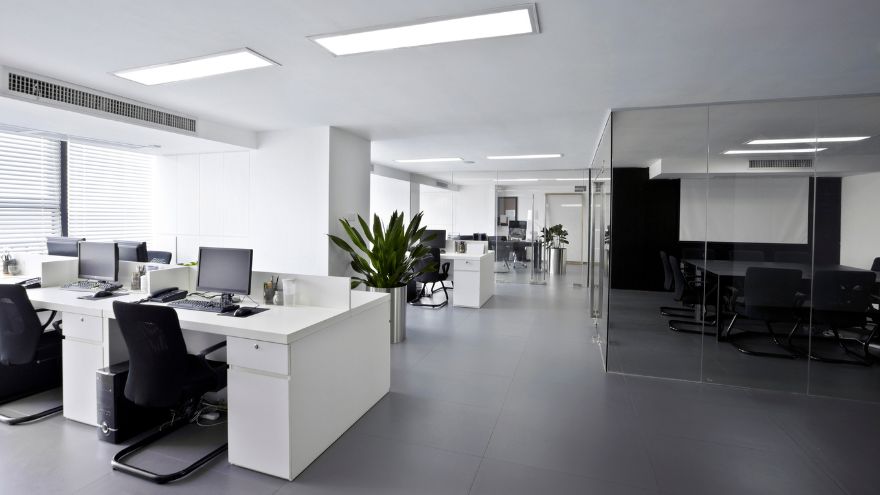
What lighting intensity must be according to occupational health and safety requirements?
In workplaces, in accordance with applicable legal regulations, the employer is obliged to provide employees with appropriate conditions for performing work. BPH provisions are very extensive, and lighting standards are determined depending on the nature of the work. One of them is appropriate lighting.
The values given in the health and safety regulations are specified by the PN-EN 12464-1:2012 standard, as well as the provisions contained in the Regulation of the Minister of Labor and Social Policy. Specific values are given depending on the type of work, light sources and room. As a rule, the greater the precision of the activities performed, the greater the light intensity should be.
According to the regulations, the lighting intensity should be:
- in office work at least 500 lx;
- when working in production halls and warehouses - not less than 200-300 lx;
- in work requiring greater precision, such as manual work related to the assembly of small electronics — 750-1000 lx;
- in design work, in laboratories — minimum 1000 lx.
It should be remembered that it is not only the power of the light that counts, but also its correct distribution. Staircase lighting and corridors do not have to be so intensely lit, here the standard pn provides that the intensity cannot be lower than 100 lx.
Check out the lighting offer at the Onninen wholesaler
Adequate lighting to increase office worker efficiency?
Lack of proper lighting affects not only a person's health, but also their well-being and work efficiency. Inadequate lighting of the workplace for office workers causes headaches, eye strain, general fatigue and reduced work efficiency.
Improving the efficiency of office workers depends on many factors, including the type of light, its source and intensity. One of the common problems that makes working at a computer difficult is the so-called glare, i.e. a situation in which light is reflected off the monitor. This happens when the ceiling lighting is poorly planned. In offices, it is worth considering the use of modern solutions, such as track lighting , which is more flexible and allows the light source to be set so that it does not hinder employees in performing their duties. Another good solution is to use desk lamps, preferably if they allow you to adjust the setting.
Proper lighting of the workstation should take into account the use of not only artificial light, but also natural light. If the layout of the office space allows it, the presence of daylight should be used to the maximum.
A solution worth considering is the choice of dynamic light. It will allow you to adjust the intensity of light and color, depending on current needs. Especially if the office has access to daylight, the needs change, depending on the time of day.
What parameters must lighting in the workplace meet?
According to the regulations, the level of lighting intensity depends on the nature of the work. For people performing administrative and office work, the value cannot be less than 500 lx, similarly in the case of work related to reading and writing by hand.
The intensity of lighting at the workstation is not the only parameter that affects the comfort and safety of employees. The type of light also has a major impact. Here, the color temperature expressed in Kelvin and the color rendering index, or CRI, must be taken into account.
In terms of temperature, there are three types of light:
- natural light, with a temperature of around 4000-5000 Kelvin, which works best in offices;
- cold light, with a temperature above 5000 Kelvin, mainly used in conference rooms;
- Warm light, with a temperature below 3500 Kelvin, is a solution that will not work in the office, only in relaxation zones.
The second important factor is the CRI. As a standard, offices should use a CRI of at least 80, because it allows for natural color rendering. In places where precision is important, e.g. when preparing projects or graphic work, lighting with a CRI of at least 90 will work better.