Where precision and perfection count, bench grinders will certainly prove themselves. These are efficient and multifunctional devices that allow for the processing of various materials. What types of work are bench grinders used for? And how to choose the right variant of the device?
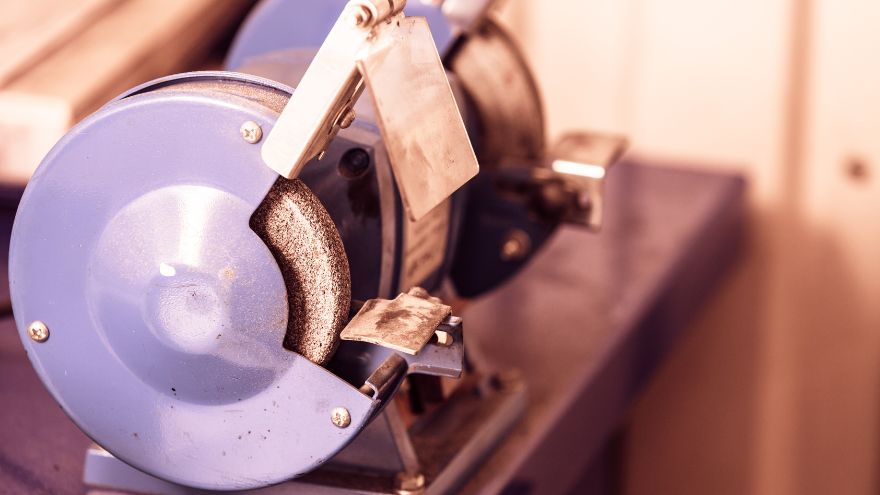
Check out the bench grinders at the Onninen wholesaler
How does a bench grinder help?
The main task of a bench grinder is to process the material, allowing to obtain a smooth surface by removing the top layer of the material - wood or metal. Depending on the needs, appropriately sized abrasives are used, dedicated to different materials. Higher values of paper grit allow to remove more material.
With a lower grit value, a smaller surface will be ground, and the material being processed will become less rough. Additionally, a bench grinder allows you to sharpen selected tools, such as drills, knives or chisels. Thanks to the grinder, you can also get rid of burrs that appear when cutting surfaces, but among the applications, you can also mention polishing or smoothing details.
How to choose the right power for a bench grinder?
Many factors influence effective work. When looking for a solution that is right for you, you should first of all pay attention to key parameters, such as power, speed, power supply variant. However, one of the most important is power, which will determine the efficiency of the device. Before buying, you should consider what materials and work the device will be used for.
 Machining hard materials in harsh, industrial conditions certainly requires the use of more powerful bench grinders. Incorrect matching of power to the nature of the work performed will result in the task not being properly completed. For small, home-based jobs, performed as a hobby or occasionally, devices with a power of 150 - 350 W will work well. However, where more efficient solutions are needed, which will be used intensively, it is definitely better to choose a power of 200 to 600 W.
It is important to be aware that the power of the device directly translates into the rotational speed. A higher value means greater efficiency, so where a professional approach is necessary, higher power will be necessary.
What to look for when choosing a bench grinder for your garage?
Power, reliability, solidity and durability are the features that a good quality bench grinder should have. There are many models available on the market, supplied by different manufacturers. It is best to choose brands that specialize in the production of specialist equipment, because this is a guarantee that the selected device will work reliably.
Different types of stone are used in angle grinders. Depending on its color (the material it is made of), the devices are adapted to process different types of materials. Starting from stainless and black steel, to sharpening concrete drills and processing cutting tools.
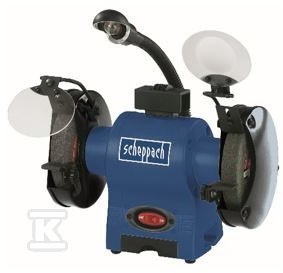
 The Onninen installation wholesaler offers excellent quality devices, such as the Scheppach BG 150 bench grinder . This solution was prepared by Scheppach , a German manufacturer that has been operating in the equipment industry for years, specializing in construction machinery and concrete mixers, as well as woodworking machines. The device has a power of 500 W and is powered by a current of 230 V. This model, designed for discs with a diameter of 150 mm, allows you to achieve a rotational speed of 2850 rpm. It is perfect for sharpening tools. A great advantage is that the device is equipped with a safety lamp, engine protection and an adjustable stand.
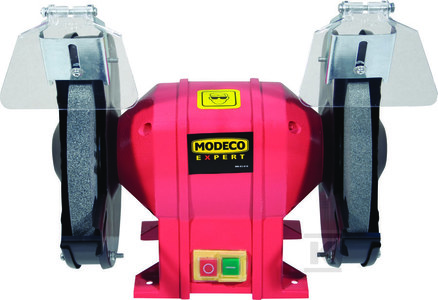
The Modeco Expert 350 W bench grinder is also very popular. It is worth noting that the device uses a brushless motor, and the screens protecting the aluminum body can be adjusted. Thanks to this, the user is perfectly protected against sparks escaping from the device during its operation. The lack of brushes in the engine means that the device is durable and solid, as well as reliable. The aluminum used to make the body not only ensures durability, but also supports heat dissipation. There are special holes at the bottom of the device, allowing easy attachment of the device to the table (worktop). Immobilizing the machine has a positive effect on improving the precision of operation.