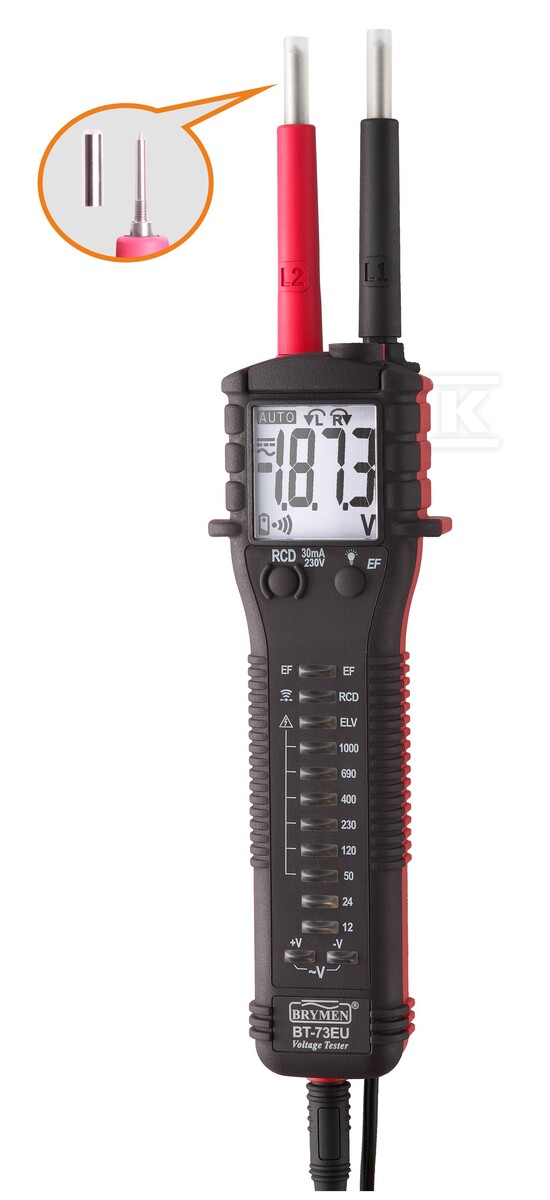
Voltage indicator BT73EU LCD/LED 1000V AC/DC, RCD, TKF, continuity test, EF 102171
Suggested products
TECHNICAL DATA
Sales unit dimensions and weight: 1 pcs
Voltage indicator BT73EU LCD/LED 1000V AC/DC, RCD, TKF, continuity test, EF 102171
Safety and Precision in One Device
The requirements placed on professionals in the energy sector are increasingly demanding, and this voltage indicator has been designed to handle circuits up to 1000 V. This device is not a simple voltage tester but an advanced measuring instrument that combines True RMS meter functions with a voltage indicator. Certified in accordance with EN61243-3:2014 (Edition 3) and rated for safety classes CAT III 1000V and CAT IV 600V, it enables safe operation in challenging installation environments. This is crucial for installers working on main distribution boards where the risk of voltage surges is real.
Versatile Measurement and Detection Functions
The main advantage of this model is its versatility. The backlit LCD display with 1999 counts provides accurate readings of AC and DC voltage in the range from 1 V to 1000 V. Fast sampling (5 times per second) allows for immediate response during dynamic measurements. Importantly, the device features True RMS, ensuring accurate readings even with distorted voltage waveforms typical of modern loads powered by inverters or controllers.
In addition to standard measurements, this model offers a range of extra functions that simplify diagnostics:
- RCD Trip Test – quick verification of residual current device operation without the need for an external impulse current generator.
- Phase Rotation Test (TKF) – two-pole detection of motor rotation direction in the range from 165 V to 1000 V, essential during the installation of pumps or industrial fans.
- Non-Contact Detection (EF/NCV) – detection of electric fields without physical contact with the conductor, enhancing safety during preliminary installation checks.
- Vibration Alarm – an additional warning signal upon detection of AC voltage, useful in noisy environments or when hands are occupied with other tools.
Reliability Even Without Power
Special attention should be paid to the device's design, which accounts for emergency situations or battery depletion. The indicator includes LEDs showing the presence of AC and DC voltage, as well as an ELV (Extra Low Voltage) threshold indication function, both of which operate even after the batteries have been removed. This allows the installer to quickly verify the presence of potential on a conductor "live," without wasting time replacing batteries at a critical moment. Additional features include a flashlight for work in poorly lit areas and an intelligent auto-off function that prevents battery drain if the device is accidentally left on.
The practical application of individual functions is as follows:
- The True RMS function ensures accurate voltage measurement even in circuits with non-linear loads, where traditional meters would fail due to harmonic distortion.
- The RCD test enables quick checking of residual current devices directly in distribution boards without using external impulse current generators.
- The TKF function is invaluable during the commissioning of three-phase motors, allowing verification of phase sequence before connecting the mechanical drive.
- EF detection allows safe identification of live conductors through insulation, minimizing the risk of electric shock during diagnostic work.
- The Vibration Alarm provides confidence regarding the presence of AC voltage even when the user is not directly looking at the device display or working in a noisy environment.
This device meets rigorous EU safety standards (CE marking), making it a trustworthy tool for every electrician working in compliance with HSE regulations. Its compact design and intuitive interface make it a natural addition to the toolkit of any professional working with low and medium voltage installations.
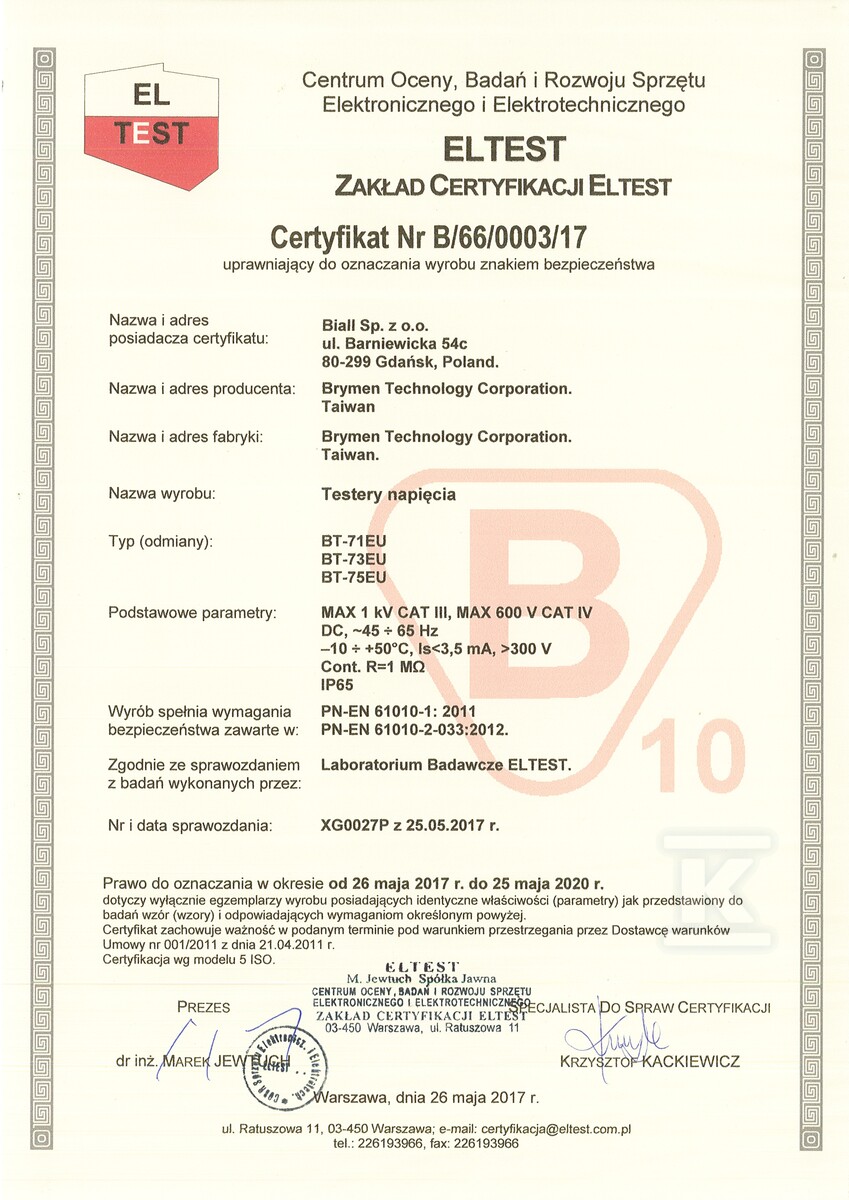
CERTIFICATES, APPROVALS, SAFETY, COMPLIANCE AND WARNINGS
EC Declaration of Conformity
Attachments
- D_102171.INSTRUKCJA_EN..2017-04-12.2
- D_102171.INSTRUKCJA_EN..2017-04-27.1
- D_102171.INSTRUKCJA_PL..2017-04-27.1
- D_102171.KARTA..2022-02-03.1
- D_102171.KARTA_EN..2017-03-27.1