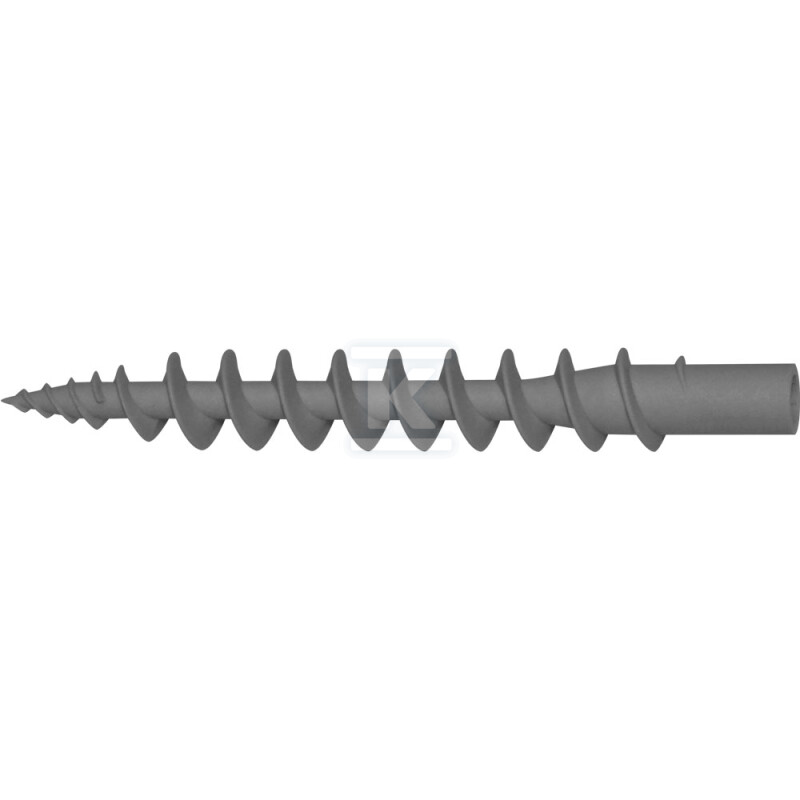
Thermal insulation screw, 80 mm length, 8 mm diameter, for a 4.5 mm screw. Quantity per package: 50 pieces. 9GR80IPSD

Suggested products
TECHNICAL DATA
Sales unit dimensions and weight: 1 pkg
Thermal insulation screw, 80 mm length, 8 mm diameter, for a 4.5 mm screw. Quantity per package: 50 pieces. 9GR80IPSD
Quick, bridge‑free installation on thermal insulation
The IPSD 80 screw is a solution created for installers who need fast, safe and thermally insulated mounting of light elements directly in the insulation layer. It requires no pre‑drilling – the sharp, drilling tip penetrates polystyrene boards, rigid foams or wood‑fiber boards, even through a thin plaster layer (up to 7 mm), shortening installation time and eliminating the risk of damaging the insulation.
Designed from glass‑fiber‑reinforced nylon, it is UV‑, moisture‑ and ageing‑resistant – it does not become brittle or deform under extreme temperatures. This is crucial for long‑term stability of fixings on external façades.
No thermal bridge – no compromises
Every hole in the insulation is a potential thermal bridge. The IPSD 80 eliminates this problem: its construction allows direct screwing of a 4.5 mm screw (e.g., 4.5×25) without heat conduction through metal. The screw remains in the insulating material as an “internal nut”, and the bolt is installed manually – after removal only a small hole remains, which does not affect the wall’s overall thermal performance.
The TX25 socket enables mounting with a battery‑powered tool – ideal for work at height or with large quantities. The possibility of pre‑installation (pre‑mounting) allows precise positioning before the final screw tightening.
For sensors, profiles and light constructions
Ideal for mounting:
wall‑mounted connection profiles,
cornice and base trims,
motion sensors, cameras and external lighting,
small metal and signalling elements.
A load capacity of about 6 kg ensures stability even under dynamic wind loads. The 80 mm length is optimized for most ETICS systems – it is sufficient for deep embedding in the insulation board without risk of breakthrough.
A water‑tightness test performed according to DIN EN 1027 method A confirms its resistance to water penetration – it does not let rain through even after prolonged exposure.
CERTIFICATES, APPROVALS, SAFETY, COMPLIANCE AND WARNINGS
Attachments