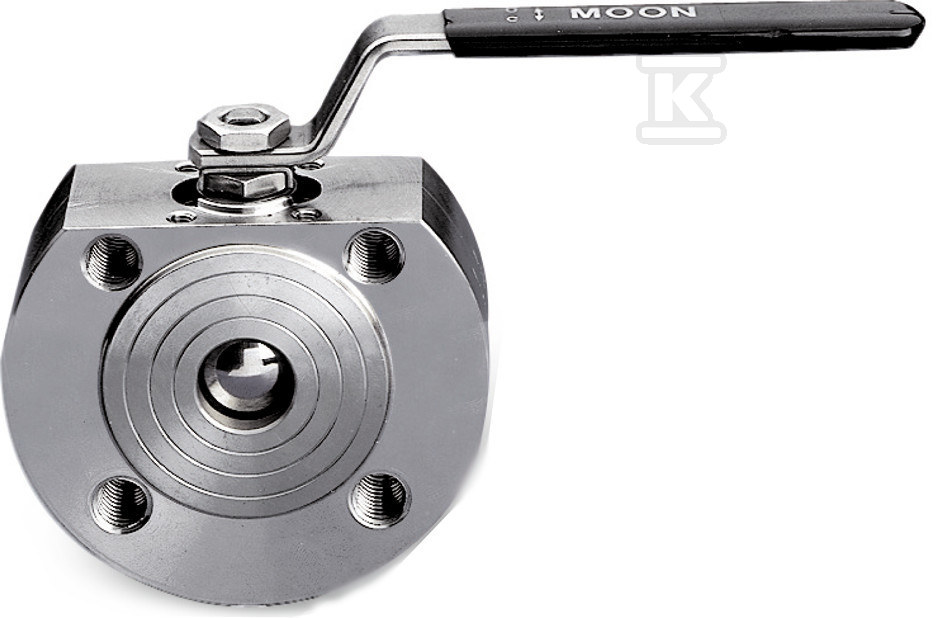
Ball valve flanged MOON DN100 PTFE stainless steel casting 2861X612
Suggested products
TECHNICAL DATA
Sales unit dimensions and weight: 1 pcs
Ball valve flanged MOON DN100 PTFE stainless steel casting 2861X612
Flanged ball valve is a solid solution for various industrial and technical installations. Made of high-quality AISI 304 stainless steel casting, it ensures durability and corrosion resistance, which is crucial in demanding environments. Designed for use with media such as water, steam, or chemicals.
Design and application
This valve, with a nominal diameter of DN100, is characterized by a full bore, which minimizes pressure loss and increases installation efficiency. Its flanged design facilitates assembly and disassembly, and also ensures a tight connection. The ball seal made of PTFE guarantees reliable operation in a wide temperature range – from -20°C to +180°C. The possibility of using PTFE + CRB or PEEK seals extends the operating temperature range to 200°C and 260°C, respectively.
The valve finds application in:
- industrial heating,
- steam installations,
- chemical and food industries,
- water installations,
- vacuum systems (up to 10e-2 mbar).
Parameters and advantages
The ability to withstand working pressure up to 16 bar makes the valve suitable for systems with increased requirements. The use of AISI 304 stainless steel for both the body and the ball ensures high corrosion resistance and long life. PTFE as a ball sealing material minimizes friction and ensures smooth opening/closing of the valve. This makes the valve reliable even with frequent use.
The body material is AISI 304 stainless steel, and the ball material is AISI 304/316 stainless steel. The handle is made of AISI 304 stainless steel, and the ball seal is PTFE (with the option of PTFE + CRB or PEEK). The working pressure is 16 bar, and the operating temperature is in the range of -20°C to +180°C (up to 200°C with PTFE + CRB and up to 260°C with PEEK). The nominal diameter is DN100, and the flow is full.
This valve is an investment in the reliability and safety of the installation – both for professionals involved in assembly and for end-users expecting trouble-free operation.