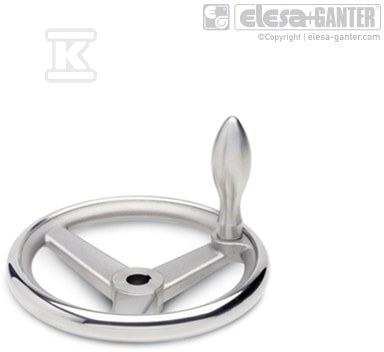
Handwheel GN 950.6-125-B12-F Z048510

Catalog numbers:
- GN 950.6-125-B12-F
Suggested products
TECHNICAL DATA
Sales unit dimensions and weight: 1 pcs
Handwheel GN 950.6-125-B12-F Z048510
Handwheels – precision and durability in every turn
The GN 950.6-125-B12-F handwheel is an element used for manual control of machines and devices. Made of stainless steel AISI 316L (A4), it guarantees high corrosion resistance and long-term reliability, even in harsh industrial conditions. It is an ideal solution for both demanding applications and standard uses in production or automation.
Design and materials – the key to performance
The use of stainless steel AISI 316L (A4) is not only a matter of corrosion resistance. This grade of steel is also characterized by high mechanical strength and dimensional stability, which translates into the precision and smoothness of the handwheel's operation. Thanks to this, installers can be sure of a solid installation, and end-users – trouble-free operation for a long time.
- Stainless steel AISI 316L (A4): provides exceptional corrosion resistance, especially in chemically aggressive or moisture-prone environments.
- Solid construction: guarantees stability and precision during use, minimizing the risk of looseness or mechanical damage.
- Versatility: the handwheel finds application in a wide range of machines and devices, from simple mechanisms to advanced automation systems.
Applications and benefits – for the installer and user
The GN 950.6-125-B12-F handwheel is a component used wherever precise manual control of linear or rotary motion is required. It is particularly useful in situations where accurate adjustment of position or force is necessary.
- Production machines: adjustment of element position, setting operating parameters.
- Laboratory equipment: precise positioning of the sample or research element.
- Industrial automation: control of valves, gates or other system elements.
- Medical devices: adjustment of the height of operating tables or positioning of surgical lamps.
- Machine assembly: Enables quick and precise positioning of components during machine assembly and servicing.
- Durability and reliability: Reduced risk of downtime related to component failures – saving time and costs for the end-user and positive feedback on the installation for the installer.
- Resistance to external factors: Possibility of use in harsh industrial conditions without fear of corrosion or damage – increased work safety and long device life.