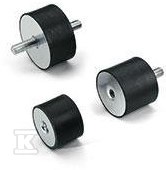
Vibration isolator DVA.3-8-8-M3-40 Z049945

Catalog numbers:
- DVA.3-8-8-M3-40
Suggested products
TECHNICAL DATA
Sales unit dimensions and weight: 1 pcs
Vibration isolator DVA.3-8-8-M3-40 Z049945
Vibration Isolators – Reduction of Vibrations and Noise
Vibration isolator DVA.3-8-8-M3-40 is a vibration damping element designed for mounting machines and equipment where reducing vibrations and noise is crucial. The construction based on rubber with a specific hardness, combined with steel inserts, ensures effective isolation and stability. It is an ideal solution for both precise devices and those exposed to higher loads.
Construction and application
The vibration isolator is characterized by a cylindrical shape and an internal thread M3 on both sides. A diameter of 8 mm and a height of 8 mm make it a compact element, easy to integrate with various structures. Made of rubber with a hardness of 40 Shore’a, it effectively absorbs vibrations, minimizing their transfer to the environment or sensitive components. Galvanized steel inserts provide mechanical strength and corrosion resistance.
This type of vibration isolators finds application in many industries:
- Mechanical engineering: reduction of vibrations of engines, pumps, fans.
- Electronics: isolation of delicate electronic components from vibrations.
- Furniture industry: damping vibrations in household appliances or industrial furniture.
- Automation: stabilization of sensors and other automation elements.
- Construction: reduction of noise and vibrations in ventilation and air conditioning installations.
Key features and benefits
- Effective vibration isolation: rubber with a hardness of 40 Shore’a provides optimal vibration damping over a wide frequency range.
- Durable construction: galvanized steel inserts guarantee resistance to mechanical loads and corrosion.
- Easy installation: internal thread M3 enables quick and secure mounting to the device or machine structure.
- Compact dimensions: small size allows for use in limited space.
- Versatility: suitable for various industrial and commercial applications.
- Noise reduction: reducing vibrations directly translates to lowering the noise level generated by devices. This is important both for work comfort and meeting acoustic safety standards.