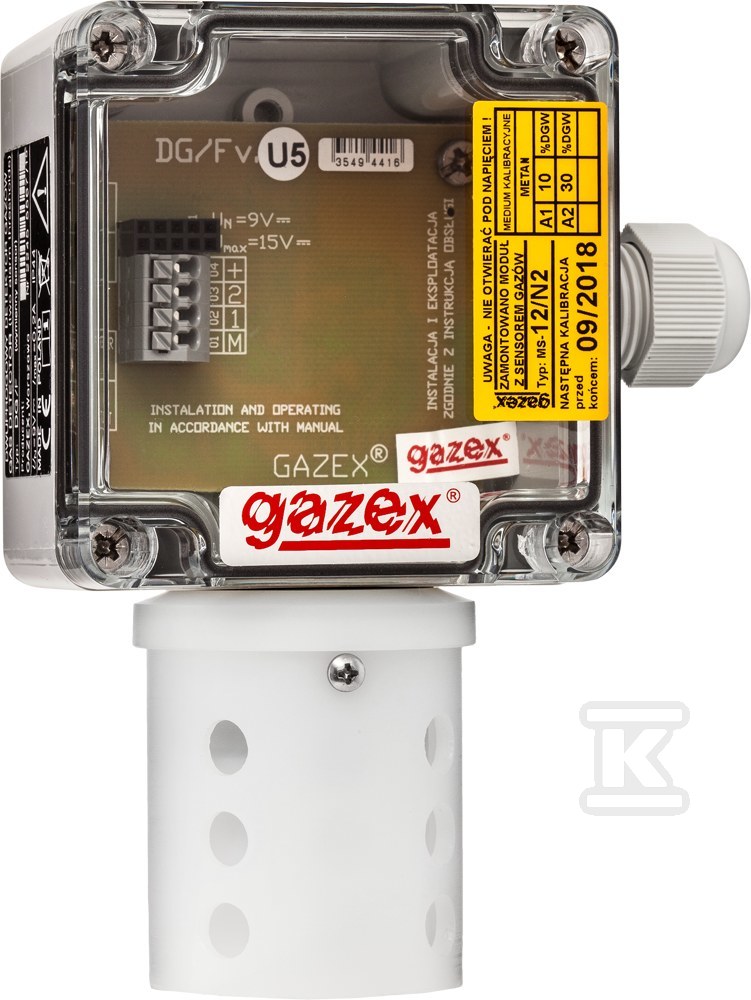
Gas detector DG-P1R2/N methane, 100% DGW, IR sensor

Suggested products
TECHNICAL DATA
Sales unit dimensions and weight: 1 pcs
Gas detector DG-P1R2/N methane, 100% DGW, IR sensor
Gas detectors – reliable safety in your work environment
This stationary, measuring gas detector DG-P1R2/N is designed for continuous monitoring of methane presence in industrial and enclosed spaces. Equipped with an optical sensor (Infra-Red), it provides a precise measurement of gas concentration, signaling when permissible levels are exceeded. The device is ideal for both professional installers and end-users looking for a reliable gas detection system.
Precision and versatility in one device
The DG-P1R2/N detector offers an analog output in the 4-20 mA standard, enabling easy integration with various control and monitoring systems. Compatibility with GAZEX control modules (MDP-1.A/T, MDP-1 PLUS, MDP-4, MDP-8, MDP-16, MDD-1, MDD-1/T, MDD-1x/T) and other central units accepting a 4-20 mA signal provides flexibility and adaptation to individual needs. It is worth remembering that when using with control units from other manufacturers, GAZEX recommends using DG/PV type detectors with dual outputs (4-20mA and 2-10V).
- Infra-Red Sensor: Provides high selectivity and accuracy in methane measurement.
- 4-20 mA Output: Enables easy integration with existing automation and control systems.
- Dimensions: Compact dimensions (110 x 140 x 55 mm) facilitate installation in various locations.
- Calibration: All detectors are calibrated in their own GAZEX Calibrating Laboratory accredited according to PN-EN ISO/IEC 17025 (PCA accreditation no. AP150), which guarantees the reliability of measurements.
- Splash-proof housing: Provides protection against moisture and dust.
Design and operation – simplicity and reliability
The DG-P1R2/N detector features a modular design, making it easy to replace sensor modules and minimize operating costs. Replaceable sensor modules have built-in thermal and linear compensation algorithms and measurement history, ensuring accurate results even in changing environmental conditions. The device is easy to install and does not require calibration on-site – this saves time and costs for the installer. The sensor is resistant to temporary increases in gas concentration, however, prolonged exposure to high concentrations may require calibration.