In a modern electrical installation, various devices operate to ensure safety – for people and devices. The basis for safe work with electricity is the isolating switch. How does this inconspicuous element work? When is it worth using it? How does it differ from an overcurrent circuit breaker? And which isolating switch should you choose?
Check the isolating switches at the Onninen wholesaler
How does a switch disconnector work?
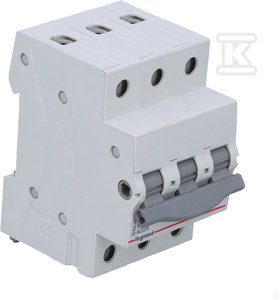 Isolating switches are used to control the flow of current, or more precisely, to safely and controlled disconnection of circuits from the power source. In most cases, mounted in a distribution box, they function as the main power switch. The isolating switch is operated, as a rule, manually.
When we turn off the switch, we disconnect the circuit. The use of isolating switches has a significant impact on the safety of maintenance and repairs carried out within the installation. In emergency situations, e.g. in a state of fire or electric shock hazard, the switch allows for immediate cutting off of electricity in the entire house or in the switchboard. After the danger has ceased, we can quickly restore continuity.
When is it advisable to use a switch disconnector?
The switch disconnector is a key element of the electrical installation, both in residential buildings and in commercial facilities and manufacturing plants. This device plays a supplementary role, so you won't find it in every distribution box, but it is worth using it if you want to safely perform installation work in the switchboard and be able to effectively respond to critical situations, such as a fire outbreak in the house. After switching off the switch disconnector, the only place in the switchboard with voltage will be the screw terminal with the phase wire connected.
What types of switch disconnectors are there?
Isolating switches differ in terms of the parameters they offer. The most common types are the number of poles. So we have:
-
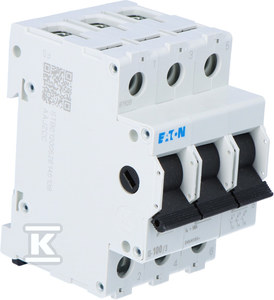 1-pole disconnectors,
 - 2-pole disconnectors,
- 3-pole disconnectors,
- 4-pole disconnectors.
1- and 2-pole switch disconnectors are designed for single-phase installations, while 3- and 4-pole models are designed for three-phase installations, where they provide disconnection of three phases simultaneously or three phases and a neutral conductor (e.g. 3p+n switch disconnector ).
Isolating switches also differ in terms of the value of the rated current supported, the degree of protection, short-circuit strength and a few other technical parameters. Therefore, the selection of the appropriate isolating switch and its installation should be entrusted to a qualified electrician, who will take into account the specifics of our installation, including the total current consumption in the circuit and other protections and elements of the system. Specialists from the Onninen wholesaler also provide support in the selection of disconnectors.
What is the difference between a switch-disconnector and a circuit breaker?
Isolating switches are often confused with circuit breakers. No wonder - at first glance, both devices look very similar. However, they operate differently and are used for different purposes.
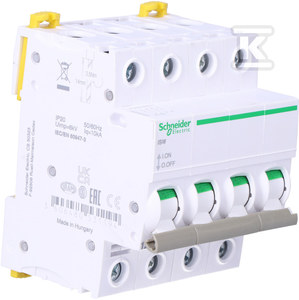 The switch disconnector is used to disconnect the power supply. The circuit is temporarily separated from the supply voltage. The operation of the device is not affected by the increase in current in the circuit. In the event of an overload or short-circuit current, the circuit should be interrupted not by the switch disconnector, but by the overcurrent circuit breaker.
A circuit breaker (also known as a plug or fuse) protects the electrical installation and devices connected to it from the effects of overloads and short circuits, e.g. fire. When a short circuit or electrical overload is detected, the circuit breaker will interrupt the power supply to the circuit, preventing the melting of insulation or damage to the wires leading to the receivers.
The difference is also visible in the housing of the switch and circuit breaker. On the switch, we will only find the current intensity value that will not damage the switch. However, we will not find a marking of the operating characteristic, because the device is switched on and off manually using the hand/fingers. On the other hand, the switch has a rated current marking (usually) B16. A fuse switch is also used to protect electrical installations, which combines the functional features of a switch and a fuse.
Switch disconnectors at the Onninen wholesaler
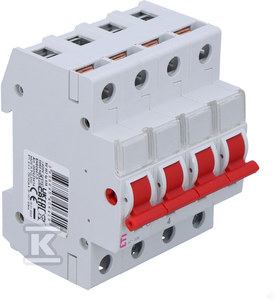 A reliable, correctly selected and installed switch disconnector enables immediate disconnection of the circuit in emergency situations or for maintenance or repair work. It is an investment in safety – yours and your electrical system.
In the Onninen electrical wholesaler you will find a wide range of isolating switches that meet the highest quality and safety standards and are available at competitive prices. Based on knowledge and experience, we decide which products have a chance to appear in the offer. We want to supply devices only from proven manufacturers and brands. You can order from us, among others, the Hager isolating switch and the Eaton isolating switch . We also have many other products in the field of control equipment in our assortment.