Difficult weather conditions, including strong winds, can cause many difficulties. Devices are used to monitor wind speed and direction, which in practice allows for precise observations, but also to draw conclusions used, among others, to control external blinds in buildings. How do wind sensors work? What to look for when choosing an air quality sensor?
Check out the wind sensors at the Onninen wholesaler
How does the wind sensor work?
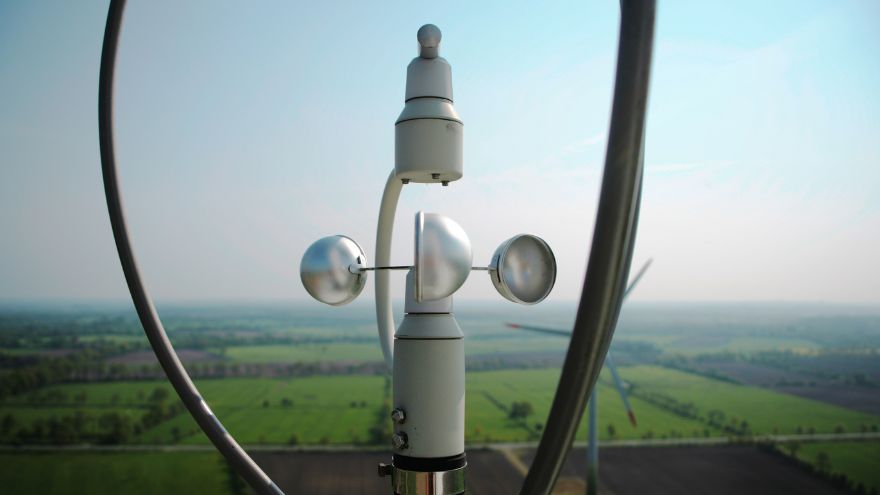
A wind sensor , also known as an anemometer or wind gauge, is a device used to measure wind speed and direction. In addition to the basic function, modern devices are characterized by additional capabilities and exceptional precision of operation, and are also exceptionally durable and solidly made.
![Wind sensor Kontakt-Simon Simon54 [WiFi] Go](https://onninen.pl/lib/images/ZG_CSQ407_ZDJECIE_GLOWNE_m.jpg) Currently, sensors that measure wind power are used in many areas, not only for monitoring weather changes. Their main task is to support safety, which is why they are used in aviation, construction and maritime navigation, among others. Data read from devices allows for making key decisions on time, which often affect the health and lives of many people. Anemometers are also used in the agricultural industry, where the obtained wind power measurement allows for proper planning of individual works. They are also perfect where renewable energy is used.
Currently, sensors that measure wind power are used in many areas, not only for monitoring weather changes. Their main task is to support safety, which is why they are used in aviation, construction and maritime navigation, among others. Data read from devices allows for making key decisions on time, which often affect the health and lives of many people. Anemometers are also used in the agricultural industry, where the obtained wind power measurement allows for proper planning of individual works. They are also perfect where renewable energy is used.
The principle of operation of the wind sensor is related to the device variant. There are rotational (rotary) models, including fan and bowl, tilting, thermal, pressure and Doppler models, which use the properties of sound frequency (so-called ultrasound). The simplest of them are solutions using rotation, in which moving elements located on the housing are set in motion at a specific speed, depending on the wind force. Modern technology allows for precise recording of the obtained measurement results. Modern proposals from leading manufacturers on the market can be used both outside and inside buildings. Due to their high accuracy of operation, they allow for observing even the smallest gusts.
What to consider when choosing an air quality sensor?
In addition to measuring wind force , an air quality sensor is also a frequently used device. It will prove useful wherever continuous and regular monitoring of indoor air quality is necessary. This is a specially designed meter that allows determining the presence of specific substances in the air, also indicating their quantity. For example, these are PM2.5 and PM10 dusts, although modern devices are also used to determine humidity in a room, and the air temperature or wind axis are also provided. High precision and operational reliability are key features of the latest commercially available devices.
 When looking for a solution that is right for you, it is best to be guided by specific data, which is why you should first and foremost pay attention to the technical specifications of the selected device. Important information provided by the manufacturer concerns the construction and operation of the device: dimensions, probe diameter, method of operation or types of measurements performed, as well as safe operating principles. The efficiency and accuracy of measurement are particularly important. Depending on the parameters, the equipment can be used in various industries. Individual models should be adapted to individual needs and expectations.
Wind sensors at the Onninen wholesaler
Wind and its power can be used in many ways, and devices such as anemometers are becoming more and more common. A great convenience is the possibility of convenient installation, as well as easy and intuitive operation. The differences between the models available for sale are related to the construction and mechanism of operation of individual solutions.
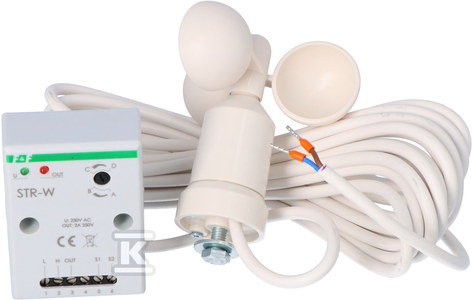
Onninen offers professional solutions prepared by valued manufacturers such as: F&F, Hager or Kontakt-Simon. One of them is, for example, the F&F STR-W wind force sensor , which also allows for measuring air speed and temperature. The device is installed outside and, after connecting it with the appropriate controller, allows for monitoring wind flow and performing specific tasks, such as controlling roller shutters. The design and mechanism of operation allow for setting the maximum permissible wind speed, air flow, and when the ceiling is reached, special mechanisms are activated, allowing, for example, lowering roller shutters or rolling up awnings, which proves that the device can be not only research-oriented, but also functional. This model has been equipped with two operating modes - continuous and pulse.
 An alternative solution is the Kontakt-Simon Simon54 [WiFi] Go wind sensor . One of the more interesting solutions used in this variant is the Wi-Fi module included in the model, which definitely makes it easier to transfer the collected data directly to a computer or mobile device, such as a smartphone. Weather monitoring takes place in real time. Another big advantage is the ease of installation, because the sensor can be placed on a specially prepared tripod or a building wall. This model is characterized by high resistance to atmospheric factors. It is resistant to liquids, mainly water, which cannot penetrate the interior of the device.
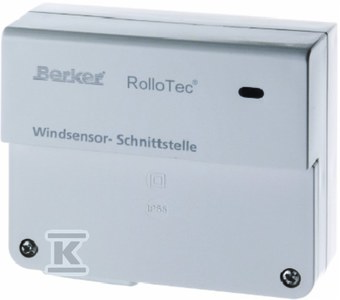
The overview of products available at Onninen, gathered in the category of wind sensors, also includes additional accessories and equipment, including the Hager 173 wind sensor controller . Durable, reliable, made of high-quality materials, it is designed to monitor and control systems using renewable energy sources, which also allow you to control the air temperature.