The principle of operation of gas condensing boilers is to use the energy from the combustion of gas and the resulting exhaust gases. They are designed to use all the energy to transform it into heat. However, for this to be possible, the stove must have properly connected chimney pipes. How to do it? What does it involve?
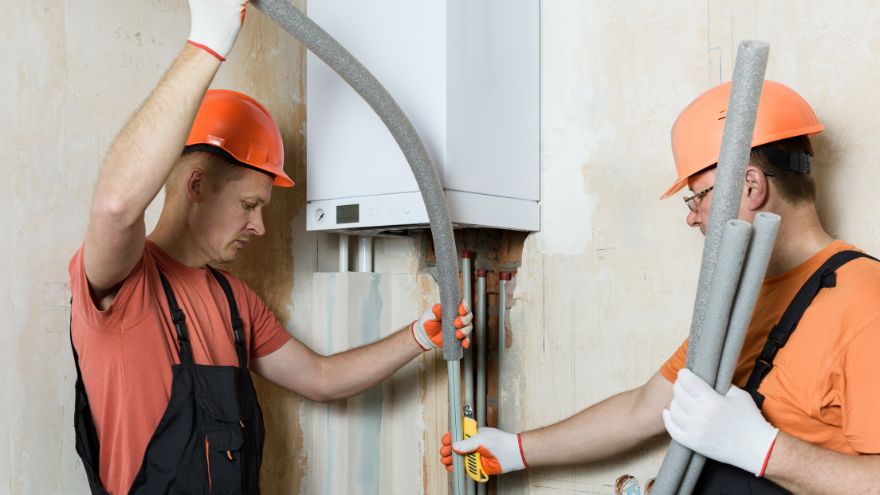
Check the chimney pipes at the Onninen wholesaler
How to properly connect chimney pipes?
 Correct connection of chimney pipes guarantees what is most important - effective and safe operation of the device. This requires taking into account several important factors. Firstly, it is important to use materials adapted to the type of fuel and the temperature of the exhaust gases. Secondly, the pipe connection must be as tight as possible to prevent leaks, and worse - carbon monoxide from entering the room. Before installation, they must be thoroughly prepared. The same as with chimney pipes, we should do with the collars. It is extremely important to remove all dirt at this stage and then degrease the surfaces. This will ensure proper adhesion of the sealing materials.
It is crucial to match the pipe to the flange so that the connection is properly made. 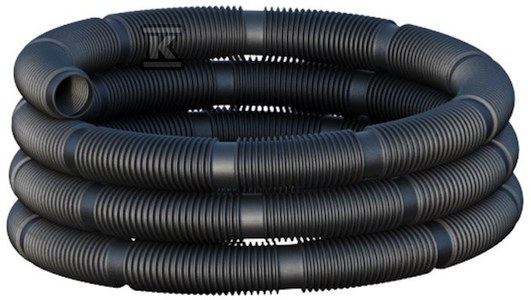 tight. We may have to use sealing materials, such as tape or sealing paste, to improve this effect. Let's connect the pipes in such a way as to reduce the resistance to the flow of exhaust gases and at the same time prevent condensation inside the pipes. Let's avoid too long horizontal sections, because in such places water vapour condenses intensively. If we connect them ourselves, it is good to consult with the appropriate specialist after the work is finished. He will assess whether we have done the installation correctly.
What diameter of chimney pipe?
Correct connection of chimney pipes to the condensing furnace has a huge impact  significance, but this is not the only important issue that must be remembered. Equally important is the selection of the appropriate pipe diameter. This largely determines how the furnace will function. A well-matched diameter affects several important parameters, such as combustion efficiency, boiler efficiency, but also minimizing exhaust gas flow resistance. To match them correctly, we must take into account the boiler power, especially since in the case of condensing furnaces there is a recommended minimum diameter for the selected power. We cannot also forget about other factors, including the length of the chimney pipe, bends and various obstacles. The rule is that the longer the pipe we are dealing with, the greater the exhaust gas flow resistance must be taken into account. For this reason, it is possible that its diameter will have to be increased so that the furnace efficiency is not disrupted.
Chimney pipe inspection at the Onninen wholesaler
We see how important it is to choose the right chimney pipes that must be properly connected. For this reason, it is worth investing in proven solutions - such can be found in the Onninen wholesale offer.
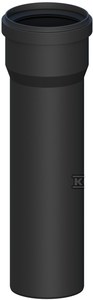
PP L1000mm DN80mm
Reliable products are available such as a straight chimney pipe PP L1000mm DN80mm resistant to UV radiation with a seal [EPDM]. Made of resistant polypropylene with a 15-year guarantee. Extremely easy to install and process.
L500mm DN60mm
Another interesting solution is the L500mm DN60mm straight chimney pipe with the same good properties as the previously described product (among others, it is resistant to UV radiation). All are offered in different sizes, so they can be easily adapted to a specific solution.
PP 12m DN60mm
Among the proposals are also flexible inserts, such as PP 12m DN60mm , which does not require connectors, without a gasket. Easy to install, also in curved, atypical, chimney shafts. This is of course only a part of the rich product offer of the Onninen wholesaler.