Renovation work requires maximum precision and accuracy. At the same time, many of them can be extremely time-consuming. Holes and gaps in the wall in particular require a quick response and the use of appropriately selected preparations. Today we will tell you how to finish gaps on a plaster wall.
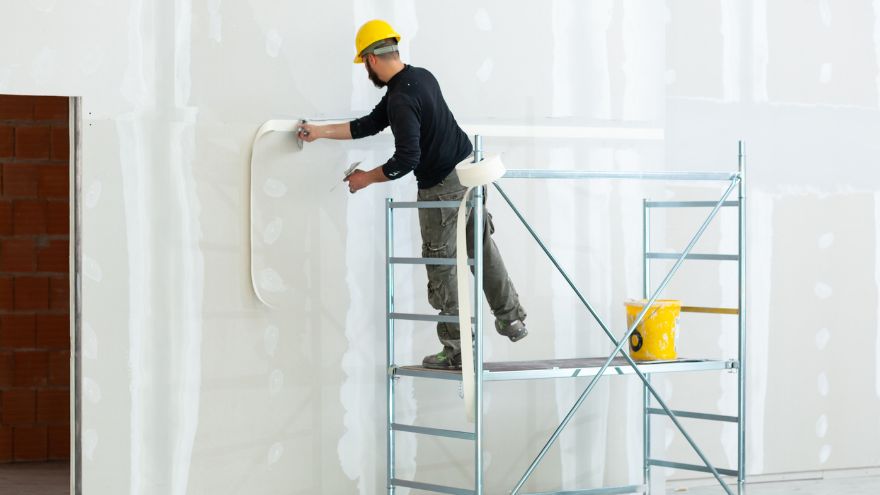
Check out Plasters, grouts and mortars at the Onninen wholesaler
How to properly plaster a wall?
 Plastering walls is based on three steps. Step one is plastering. Step two is spackling. Step three is smoothing the surface. In order for the surface to be perfectly smooth, the plastering of the walls must be done very carefully. Both gypsum plaster and gypsum plaster will work very well for this purpose, but it must be remembered that the layer of gypsum plaster should not exceed 3 mm in thickness. It can be used for cement plasters, as well as cement-lime or concrete plasters. On the other hand, gypsum plasters should be applied in one, thick layer, where the thickness should be up to 2 cm. There is no need to level the surface with a plaster.
You should also know that gypsum plasters are used for mineral substrates, which include ceramic bricks, lime-sand bricks, as well as regular and cellular concrete. In the case of highly absorbent walls, the substrate should be additionally primed, because only then can its absorbency be equalized. To plaster the wall properly, you should first clean the substrate, i.e. remove flaking paint, but also dust, dirt or dirt. Then it is necessary to fill the walls, because in this way you can level all kinds of cracks, but also fill in gaps. At the very end, apply the gypsum plaster. Mix the mortar with water. It should be applied with a wide trowel. When it dries, sand the wall over the entire surface. For this purpose, you can use sandpaper with a grain size of 100 to 150 or a gypsum sander.
What layer of gypsum plaster should be applied to the wall?
Proper execution of the work allows for the best final effect. Of course, to achieve this effect, the right materials must be selected. What layer of gypsum plaster gives the best effect? Let's start with the fact that 1 kg of gypsum plaster covers approx. 1.5 m3 of wall. Gypsum plaster is not applied in several layers. Only one layer is enough, and the key to success is the appropriately selected thickness. It cannot exceed 30 mm, and it would be best to have 25 mm. We must remember that the layer of gypsum plaster cannot be less than 5 mm.
How thick should plaster putty be?
 Gypsum plaster, or gypsum filler , is used not only to level walls, but also ceilings. It is important to know that building gypsum should be applied in very thin layers, the thickness of which cannot exceed 2 to 3 mm. It should not be forgotten that the number of layers also matters. Here, it is important to know that at least two layers should be applied. In the case of greater unevenness, there must be definitely more layers. If you intend to place some decorations or strips on the wall, you should choose the appropriate assembly glue , but it can only be used when the wall is completely dry.
Gypsum finishing products at the Onninen wholesaler
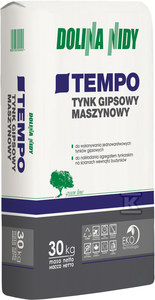
When carrying out finishing works related to leveling of wall defects, you can rely on gypsum plaster Dolina Nidy Tempo 30 kg . It is really efficient and at the same time has a favorable price. It can be applied with a plastering machine, but it should be remembered that before application the walls should be thoroughly cleaned. It is suitable for walls made of lime-sand brick, as well as ordinary and cellular concrete or light chipboard-cement boards, and even those with ceramic elements.
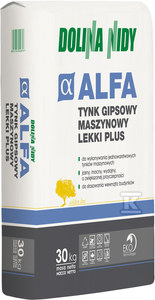 In the case of single-layer plasters, you can choose Dolina Nidy Alfa Light Plus 30 kg gypsum plaster . It is intended for interior rooms, but also ceilings. It can be used even in rooms such as kitchens or bathrooms. You need to know that this is a strong plaster. Thanks to the appropriately selected proportions, the plaster has even better adhesion. It also allows you to save, thanks to lower material consumption. 0.75 kg is enough for 1 m2 of wall while maintaining a layer thickness of 1 mm.
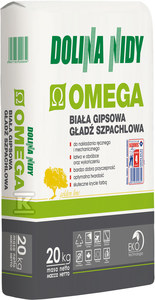
The white gypsum plaster Dolina Nidy Omega 20 kg can also work well. It works well for both manual and machine application. It provides optimum hardness, but also great adhesion. Thanks to it, you can create a strong base for both painting and wallpapering.
Check out Plasters, grouts and mortars at the Onninen wholesaler