Steel anchors are used for permanent and reliable fastening of two parts of a structure or structural elements to a substrate, mainly concrete. They work by expanding in the material. They have the ability to carry very heavy loads, which distinguishes them from expansion bolts. Made of galvanized carbon steel or stainless steel, they are resistant to corrosion and atmospheric factors. This article will teach you how to choose a steel anchor for a given type of substrate to achieve the safest and most durable effect possible.
Check out the steel anchors at the Onninen wholesaler
Steel anchor - properties and application
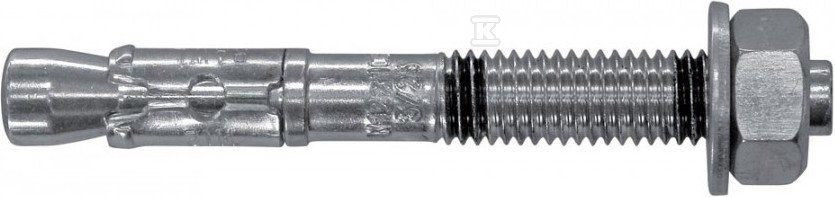
A steel anchor is a type of mechanical anchor used for so-called heavy fastening of elements to the substrate. It works on a similar principle to an expansion bolt, but can carry much greater loads. It is mainly intended for solid concrete substrates, hence its common use on construction sites and the alternative name "concrete anchor". Steel anchors are quick to install, and when properly secured, they are resistant to extreme temperatures and corrosion. They guarantee high load-bearing capacity and can be loaded immediately after use. Their relatively low price also convinces - they are usually a cheaper solution than chemical anchors. However, due to constant exposure to high stresses and the phenomenon of expansion, steel anchors may crack or crumble prematurely. They must not be loaded beyond the value allowed by the manufacturer.
Types of steel anchors
There are several main types of steel anchors. They differ in design and therefore in properties, purpose and method of installation.
- Sleeve anchors are very popular due to their versatility. They are perfect for fastening various types of elements in concrete under conditions of low and medium loads. This group also includes models with internal threads, called driven sleeve anchors. They are installed using punches, hammers, screws or threaded rods.
- For quick and easy through-the-wall installation (i.e. directly through the material being fastened), band anchors are used. Band anchors require drilling a hole in the substrate. Their key advantages include the ability to anchor elements of various thicknesses, achieving high load-bearing capacities, efficiency in uncracked concrete and good cost-effectiveness. See what properties, for example, the Rawlplug R-XPT M6x50 mm band anchor has.
- A special type of steel anchor is screw-in anchor (also known as concrete screws). They do not expand the material, which eliminates the risk of damage. Both assembly and disassembly work using screw-in anchors is safe, fast and convenient. They can be completely removed from the substrate. For this reason, concrete screws are often used for temporary installation. They can carry medium and heavy loads.
- Universal expansion anchors with ready-to-install structures are segment anchors. They consist of a rod or bolt, nut, collar or hook. They can carry very heavy loads. They are suitable for anchoring in virtually any substrate.
- Another special type are door frame anchors. Thanks to their well-thought-out design, they facilitate the assembly of door and window joinery, minimizing the risk of frame deformation during work.
Type of substrate and selection of steel anchor
The substrates in which elements are fastened using mechanical and chemical anchors differ in terms of their material, condition, class and structure. The compactness of the substrate is crucial for the durability of the fastening, the safety of the entire structure and the service life of the material. The manufacturer always decides on the intended use of a given steel anchor, providing appropriate information on the packaging or in the attached documentation. Most steel anchors are intended for anchoring in solid substrates, where they achieve the highest load-bearing capacity. Therefore, they work best with dry, undamaged concrete. If you are interested in anchoring in hollow and masonry substrates, the manufacturer must explicitly allow such an intended use - similarly in the case of applications in conditions where the metal anchor is exposed to moisture or very low temperatures. However, when planning to fasten extremely heavy structural elements (200-800 kg) to an uncertain, damp substrate, a chemical (bonded) anchor will be a safer solution.
In the Onninen electrical wholesaler, professionals can find a wide range of steel anchors for fastening elements in concrete walls and solid substrates. All products meet the highest quality and safety standards. They are characterized by high strength, universality of use and ease of installation, becoming the basis for solid structures. We cooperate with leading manufacturers of fastening systems, such as Koelner, Rawlplug and Walraven. Still not sure which steel anchor to choose for a given type of substrate? Contact us. Onninen technical and sales advisors will try to help. We also have other types of anchors in our offer, as well as expansion plugs, screws, sleeves and nails.