A sander is a very practical device, widely used by professionals as well as DIY enthusiasts. What is an orbital sander, what is it used for and how does it differ from an eccentric sander?
Check out orbital sanders at the Onninen wholesaler
Can you polish paint with an orbital sander?
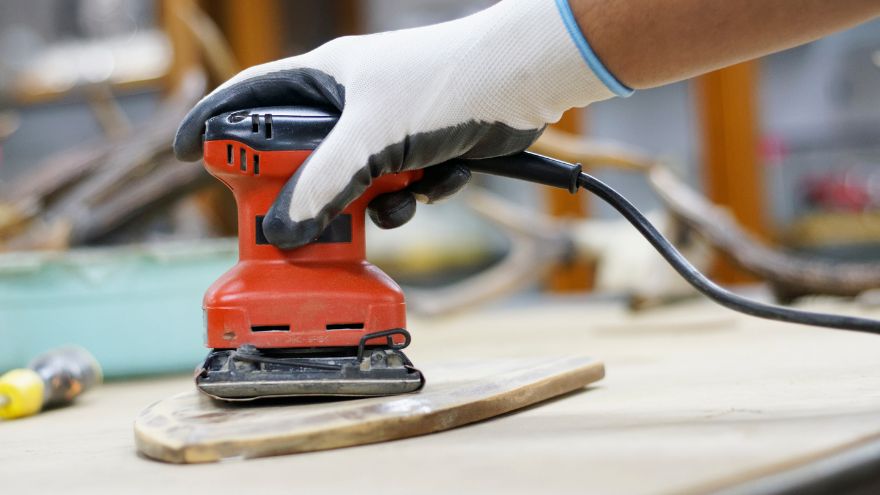
The characteristic feature of orbital sanders is their ease of use. A motor-driven foot with sandpaper of a specific gradation attached to it allows for quick smoothing of even delicate surfaces. The foot is set in an oscillating, i.e. pendulum, movement, which means that it moves steadily forward and backward. Thanks to the repeatability of movements, high vibration frequency and small amplitude, various surfaces can be very precisely smoothed.
An orbital sander is a device used to smooth flat, relatively even surfaces. It will prepare wood, plaster, stone, and some devices - concrete.
One of the more interesting applications of orbital sanders is paint polishing. In this version, the device is often used by painters and even people who want to take care of their own vehicle. In such a situation, instead of sandpaper, special pads dedicated to polishing are used. When choosing a device that can also be used to polish a car, it is worth paying attention to whether it has speed regulation.
What are the differences between an orbital and an eccentric sander?
 An alternative solution to the orbital sander is the eccentric sander. The difference between the devices is related to the principle of operation. While in the first variant the foot moves only forwards and backwards, in eccentric devices there is additionally a rotational movement, i.e. around its own axis. Eccentric devices allow operation not only on flat, but also convex and concave surfaces. All thanks to the replaceable, flexible plate. Eccentric sanders are used to smooth not only wooden surfaces, but also stone or steel ones.
The difference between the two device variants is also related to the specifics of work. With eccentric sanders, it is necessary to use the appropriate pressure, but it should be known that these models are very sensitive to pressure, so if it is too high, it can slow down the operation of the equipment.
How to choose the right orbital sander?
When looking for the right solution, you should analyze the available devices and their parameters in terms of individual needs. The most important will be - the power of the device's engine, the number of oscillations per minute, as well as the size and shape of the foot or the number of cycles.
One of the important parameters is also the size of the foot. Depending on what work will be done and how often the device will be used. For sanding larger surfaces, a device with a larger foot will definitely be a better solution. This will allow you to complete the entire task faster. The downside of this solution, however, is precision. The larger surface of the foot will not allow you to reach hard-to-reach places, so an orbital sander with a smaller foot will definitely work better for precise work. For people who deal with different surfaces and care about both precision and work speed, models with replaceable feet that can be quickly and efficiently changed, depending on your needs, can be a great solution.
The number of oscillations per minute in good quality devices ensures more efficient work. The higher the number of oscillations given by the manufacturer, the more precise and efficient the work will be. A big advantage is the ability to regulate the speed, depending on the type of work performed.
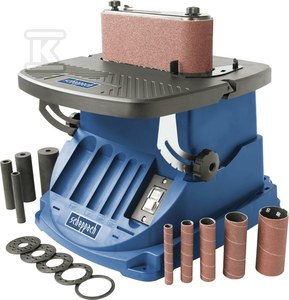
Scheppach OSM600 spindle sander
When looking for professional solutions, it is worth paying attention to the Scheppach OSM 600 spindle orbital sander . This device requiring electric power will be appreciated by both professionals and hobbyists. The Scheppach sander allows you to perform work that requires high precision, because the work table guarantees stability. A big advantage here is the ability to adjust the table, which increases the comfort of operation. The device operates at a speed of 2000 rpm, and the oscillation stroke is 16 mm.