As an employer, can you freely light the space where people work? As you can imagine – no. It is your duty to provide employees with safe and hygienic conditions, including by providing appropriate lighting at the work station. Negligence in this area can lead to various health ailments and reduce the effectiveness of the tasks performed, and expose you to serious legal and image problems. Find out what Polish Standards and legal acts say about lighting in the workplace.
Check out the lighting at the Onninen wholesaler
Lighting functions in the work environment
Lighting is the use of light to highlight places, objects or their surroundings. It affects the safety of people in a given interior, the way they perceive their surroundings and their well-being. Properly designed workplace lighting supports comfortable, safe and efficient performance of various tasks.  visual.
Lighting is considered a physical factor of the work environment - a nuisance factor, because its improper selection can lead to many negative consequences, in particular to excessive eye fatigue, the appearance of ailments in the organ of vision, a decrease in work efficiency and the deepening of existing visual defects. Therefore, employers are obliged to provide lighting in the workplace with parameters consistent with Polish Standards.
What standards and legal sources regulate the issue of lighting in the workplace?
The basic legal act is the Regulation of the Minister of Labour and Social Policy of 26 September 1997 on general occupational health and safety regulations . The regulations on lighting at workstations are contained in Chapter 2. (Lighting). According to § 26. paragraphs 1 and 2 of the regulation, the level of daylight at individual workstations should be adjusted to the type of work performed and the required precision. In addition, daylighting should meet the requirements specified in the Polish Standard. Artificial (electric) lighting is a necessary supplement to daylight. It must also have parameters consistent with the Polish Standards.
Specific guidelines on lighting of workplaces should be sought primarily in the Polish Standard PN-EN 12464-1: 2004 "Light and lighting. Lighting of workplaces. Part 1: Indoor workplaces". Although Polish Standards are not sources of generally applicable law and their compliance is generally voluntary, in the case of lighting of workplaces many provisions are obligatory for the employer.
Three Basic Types of Lighting in Workplaces
Due to the type of lighting fixtures in the work environment, we can distinguish:
- general lighting – also known as main or central lighting, it provides uniform lighting of the interior or its parts, and allows you to illuminate a given space equally or almost equally (in most cases, this function is performed by ceiling lighting);
- local lighting - the use of local lighting fixtures is aimed at, among other things:
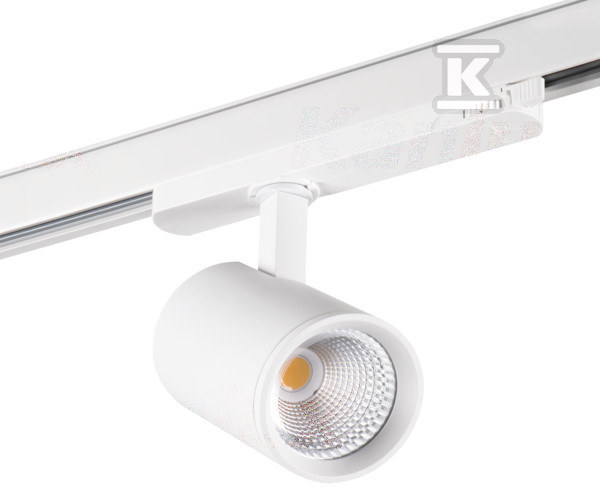 increasing light intensity and better visibility of details (taking into account the specific lighting needs of a given position);
 - complex lighting – created by general lighting and local lighting.
When planning a lighting system, it is important to consider the required level of lighting intensity in individual work and traffic areas. Currently, general lighting alone is rare.
When using local lighting, it should be remembered that it cannot cause glare. Glare causes reduced visual comfort and the ability to recognize details/objects, which reduces the precision of work and increases the risk of accidents.
Light intensity – a key parameter of workplace lighting
According to the provisions of the standard, the lighting environment is determined by the following parameters:
- lighting intensity
- luminance distribution
- revelation
- light directionality
- color rendering and color appearance of light
- gleam
The key factor influencing the speed and manner of performing visual tasks is the intensity of lighting at the workstation – its level and distribution in the visual task field and the surroundings. The minimum intensity values for various visual tasks are included in the standard. In order to be able to see the features of the human face in normal lighting conditions, the lighting intensity of at least 20 lx is necessary. If the employee performs short-term work or the objects they work with are large, the lighting requirements can be reduced by one degree according to the given scale, e.g. from 300 lx to 200 lx. Of course, the permissible flexibility in lighting design also works the other way round. It is possible to increase the intensity value if the visual tasks performed are extremely difficult, the visual ability has deteriorated (e.g. due to the employee's pre-retirement age) or the object of visual work is very small or has a low contrast value.
Are you looking for lighting for home or professional use? Check out the offer of the Onninen electrical wholesaler! We have thousands of lighting fixtures, light sources and accessories in our assortment. You will find, among others, stair lighting and track lighting . In case of questions or problems with choosing the right solutions, we encourage you to contact us. We will advise.