Underfloor heating is very convenient and practical. It allows you to enjoy thermal comfort, while at the same time preventing the multiplication of mites, which are harmful to health. It is worth noting that air circulation is minimized, which of course prevents dust from settling. It is worth choosing the right panels for underfloor heating.
Check out our offer for underfloor heating
How thick should panels be for underfloor heating?
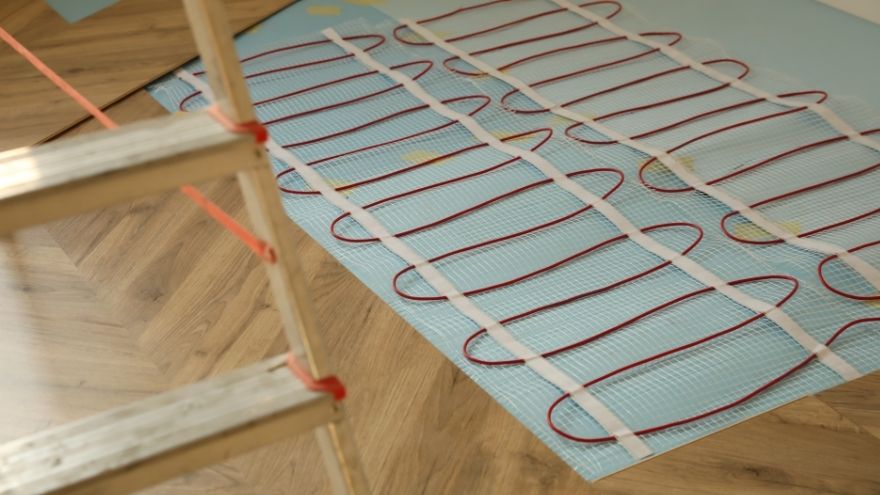
Every underfloor heating is functional. For example, you can opt for electric underfloor heating , which allows you to maintain a constant temperature in the room. It works on the principle of heat radiation, so the radiation spreads evenly throughout the room. An alternative is water underfloor heating . This is a heating system in which there are special tubes under the floor, which are heated by water. This is efficient heating. It works by circulating hot water. Of course, to enjoy the properties of such heating, you need to choose the right thickness of the panels. Contrary to appearances, this parameter is crucial for efficiency. Standard panels are 6 to 12 mm thick. There are also very thick panels, i.e. 20 mm. However, in the case of underfloor heating, it is best to choose those whose thickness is 8 to 9 mm. These can be, for example, laminated or vinyl panels. In addition, pay attention to the underlay, which should provide appropriate acoustic properties, but also thermal insulation. It is best to choose one made of polystyrene up to 3 mm thick. It has waterproof properties and ensures lossless heat transfer.
Selecting the appropriate abrasion class of panels for underfloor heating
Finding the right heating doesn't have to be difficult. When choosing, you should definitely pay attention to the aspect of energy efficiency, but also comfort. Interestingly, more and more people are opting for surface heating , a type of heating installation that does not have radiators. It must be admitted that this is a really functional solution. It ensures even temperature distribution and lower energy consumption, and at the same time users gain natural air humidity and low operating costs. When choosing this type of heating, you need to choose the right abrasion class of the panels that will fit the heating. The abrasion class of the panels should be AC3 and AC4. On the other hand, abrasion class AC6 works well in high traffic, but you cannot necessarily choose such panels when deciding on underfloor heating. In order for the panels to provide optimal heat transport, e.g. with water underfloor heating, you also need to pay attention to the thermal resistance coefficient, and in this case, laminated panels are a good solution, with a thermal resistance coefficient of 0.07 m2K/W. Thanks to this, you do not have to worry that the material will lose its properties under the influence of high temperatures, i.e. it will start to shrink or dry out. In the case of choosing panels for electric floor heating, low thermal resistance, i.e. at the level of 0.02 m2K/W, affects the efficiency of heating and ensures the correct distribution of thermal energy.
The best utility class of underfloor heating panels
The utility class of the panels is a parameter that indicates the conditions in which the panels will work best, as well as the traffic intensity they will withstand. This parameter is also taken into account when selecting materials for underfloor heating. The utility class of the panels should have a value of 31 or 32. This is due to the fact that such panels are resistant to high temperatures. Underfloor heating will work well not only in houses, but also in apartments.
You also need to remember to choose the right installation method. But before we get to that, you need to know that the temperature of the top layer of the floor cannot exceed 27 degrees Celsius, which applies to the heating period. As for the type of installation itself, it is of course best to choose panels installed using the click-clack system, which is very practical, convenient to use, and also easy to install. This is a really good alternative to gluing, which will save you a lot of time. In the case of gluing panels, you should choose the right glue that is suitable for underfloor heating systems, i.e. one that has increased standard adhesion class C2.