Photovoltaic cable (solar cable) is often an underestimated element of the entire installation, and yet the functionality of the photovoltaic set depends on it. It is a connection that delivers the energy produced from the panels to the inverter, and although their price is only a fraction of the costs incurred for the entire system, many investors see this as an opportunity to save money. Is this right? Which photovoltaic cable should you choose? What cross-section of the photovoltaic cable will be optimal?
Check out the solar cables at the Onninen wholesaler
Characteristics of photovoltaic cable
The importance of solar cables is evidenced by the fact that the problem with photovoltaics turning off at high voltage may result from poor selection of electrical wire cross-sections. The features that a photovoltaic cable should have are described in the PN EN 50618:2015-03 standard.
The photovoltaic cable should be made of materials resistant to UV radiation, moisture, weather conditions and temperature fluctuations. In the event of a fire, the photovoltaic cable should not generate smoke or toxic gases, which could pose a health risk to people participating in the firefighting operation (standards including UNE-EN 60754-2 and IEC 60754-2). It should also be resistant to mechanical damage. A low electrical resistance coefficient minimises energy losses during the flow of current from the panels to the inverter. It is also important for the photovoltaic cable to be flexible, because it is easier to form and lay on various surfaces;
 Photovoltaic installations can be located in industrial areas where there is potential chemical contamination. It is assumed that under normal operating conditions, PV cables should last at least 25 years. The solar cable should be equipped with appropriate markings confirming compliance with norms and standards for photovoltaic installations. Certificates such as TUV, UL, CE confirm compliance with specific quality standards.
The selection of the photovoltaic cable cross-section should take into account the power of the panels, the distances between the panels and the inverter, and the parameters of the current that will flow through the cable. A cross-section that is too small can cause significant energy losses, while a cross-section that is too large will increase the overall cost of the installation.
When selecting a cable, you also need to remember its length. This should be selected taking into account the distance between the panels and the inverter. A cable that is too long can cause voltage drops, while a cable that is too short can prevent proper connection.
Which cable for 10 kW photovoltaics?
For installations from 10 to 15 kW, it is recommended to use a cable with a cross-section of 6 mm². This is associated with the need to limit the loss, which at 1% for photovoltaics is considered acceptable. Installations with a power of 10 kW and above should be made using, for example, the Lapp H1Z2Z2-K 1 × 6 WH/BK solar cable .
Which cable for 6 kW photovoltaics?
For inverter power up to 7.5 kW , the Lapp H1Z2Z2-K 1 × 4 WH/BK solar cable should be used, the nominal cross-section of which will be 4 mm². This will reduce installation costs while maintaining optimal energy production parameters.
Photovoltaic cable 5 kW
 When determining the wire cross-section yourself, it is worth using a relatively simple formula:
Wire cross section = (I * n) / U * k * 0.01
The result is always given in mm².
Meaning of symbols:
n – total length of the circuit in meters;
I – current intensity IMpp in NOCT conditions (amperes);
U – UMPP circuit voltage under NOCT conditions (volts);
k – conductivity (conductivity) of the material from which the wire is made;
0.01 – allowable losses in circuits (assumed 1%).
For 5 kW photovoltaics , the Lapp H1Z2Z2-K 1 × 4 WH/BK solar cable will work perfectly. with a core cross-section of 4 mm².
Photovoltaic cable 4 kW
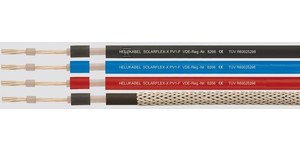
Similarly, as in the above case, there is no point in investing in a more expensive cable with a larger cross-section. A 4 kW installation will function perfectly using the Solarflex - X PV1-F 1 × 4 photovoltaic cable with a cross-section of 4 mm².
It is a good idea to entrust the selection of a photovoltaic cable, as well as the related calculations, to a person with knowledge and competence in the field of photovoltaic installations. Otherwise, there is a risk of lowering the efficiency of the system, as well as a threat to the safety of PV installation users.