Huge transformer welders are becoming less and less popular today. Due to their weight, they often had their own wheels, which slightly increased their mobility. However, they were still intended to work in one place (workshop, hall position). The introduction of inverter welders to the market completely changed the face of welding. How do they differ from their predecessors? And why is it worth investing in them? Check it out for yourself in the article below.
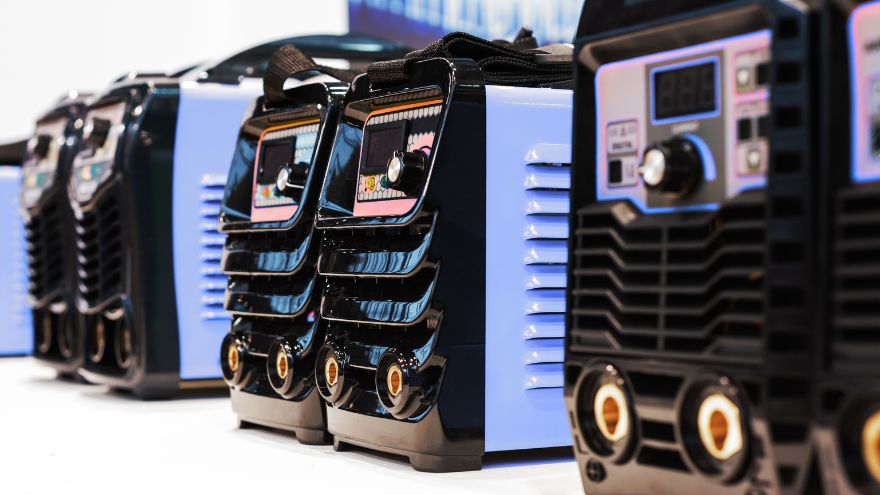
Check out inverter welders at the Onninen wholesaler
How does an inverter welder work?
The key to understanding the operation of modern portable welders is silicon technology. Semiconductors have enabled the construction of switching power supplies with a high switching frequency (often exceeding 10 kHz). The effect was a significant reduction in transformers, at the expense of installing additional components and electronic circuits that control the entire process. The device first rectifies the alternating current, converting it to direct current, and then increases its parameters to match the setting.
What can be connected with an inverter welder?
 A modern inverter welder allows welding in all popular technologies: MIG/MAG, TIG and MMA, i.e. with a coated electrode. What are the benefits of choosing models operating on silicon technology?
- The devices are very light, so you can carry them around like a light bag or suitcase. Their high mobility makes it easier to weld large elements or work in the field.
- Inverter welders draw less current. Not only do you not have to look for a power outlet for them, but they work perfectly with typical home outlets.
- Modern electronic control allows for much more accurate setting of welding parameters.
- Its small size means you can store it in your home workshop.
Theoretically, the scope of work of an inverter welder and a transformer welder is similar. In practice, however, the advantages of the former (especially its mobility) mean that it can do much more.
How is an inverter welder different from standard welders?
Do inverter welders have only advantages? Although they significantly facilitate the welder's work, they also have some disadvantages. So how do they differ from classic solutions?
-
 Resistance to mechanical damage. The simple construction of transformer welders made them extremely resistant to the conditions of use. In turn, modern models, full of electronics, are susceptible to impacts or vibrations. This means that you have to be much more careful with them.
 - Durability. Transformer technology, known for decades, has proven its durability and strength. Inverter models require more frequent servicing of the device.
- Heavy loads. The vast majority of jobs do not use the maximum power of the welder. However, in the case of particularly demanding jobs, standard models will cope better.
This means that it is still worth using a classic transformer welder for the most difficult tasks. However, inverter models provide incredible mobility and ease of work, and also generate savings through lower power consumption. They also work well in more precise work. Therefore, they are a better choice in the vast majority of cases.
Inverter welders in the Onninen wholesaler
In the Onninen installation wholesaler you can find several particularly recommended models of inverter welders. Check which one best suits your needs!
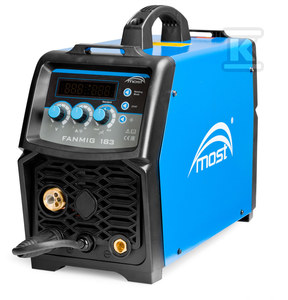
MOST MIG FANMIG 183 inverter welding machine
This model is perfect for welding steel and stainless steel in a gas shield. In the case of a noble gas, such as argon, we are dealing with the MIG method, while with the addition of carbon dioxide, we talk about the MAG method. Apart from the type of shielding gas used, these methods do not differ in the welding method. The MOST MIG FANMIG 183 inverter welder also allows for welding with a coated electrode. Thermal protection protects the device from failure due to too intensive welding. Therefore, this model will also work well in a home workshop.
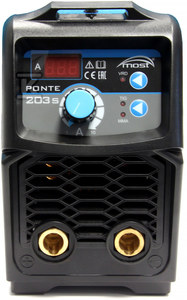
MOST MMA PONTE 203S inverter welder
 The most typical inverter welder available in the Onninen wholesaler. The MOST MMA PONTE 203S inverter welder is designed primarily for welding with a coated electrode, a simple and popular method among all DIY enthusiasts. It does not require additional gas cylinders or wire spools. The large display makes it easy to read the current settings. The device also allows for TIG welding with arc ignition by rubbing the electrode.
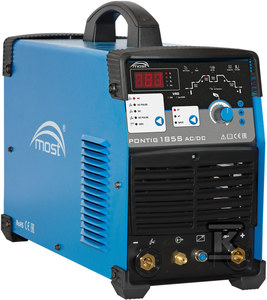
PONTIG 185S AC/DC TIG MOST rectifier
The universal TIG method allows for welding most metals. When switched to direct current, this method works well for joining steel, stainless steel, copper and all its alloys. However, using alternating current, you can weld aluminum with alloys of this metal. The MOST TIG PONTIG 185S inverter welder also has a function of welding with a coated electrode.