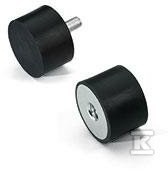
Vibration isolator DVA.5-60-30-M10-55 Z031018

Catalog numbers:
- DVA.5-60-30-M10-55
Suggested products
TECHNICAL DATA
Sales unit dimensions and weight: 1 pcs
Vibration isolator DVA.5-60-30-M10-55 Z031018
Vibration isolators – reduction of vibrations and noise in machines and equipment
The DVA.5-60-30-M10-55 vibration isolator is an element dedicated to damping vibrations and reducing noise generated by machines and equipment. Its use translates to improved work comfort, increased safety, and extended equipment life. The construction based on a combination of galvanized steel and natural rubber provides effective isolation from vibrations.
Construction and application
This model of vibration isolator is characterized by a cylindrical construction, with a galvanized steel insert equipped with a non-through threaded hole. The M10 thread allows for easy mounting in the structure of the device or foundation. A height of 30 mm with a diameter of 60 mm ensures stability and efficiency. These types of vibration isolators are widely used in industry, mechanical engineering, and everywhere where it is necessary to limit the transmission of vibrations. They can be used to mount motors, pumps, fans, as well as to insulate electrical cabinets or other elements sensitive to vibrations.
Characteristics and benefits
The use of natural rubber with a hardness of 55 on the Shore scale provides optimal damping properties while maintaining adequate elasticity. This hardness is a compromise between the ability to absorb vibration energy and resistance to static loads. The steel insert guarantees durability and resistance to mechanical damage. Installation is simple thanks to the standard M10 thread. It is worth emphasizing that the reduction of vibrations translates not only to operator comfort but also to reduced wear of machine elements and lower noise levels in the environment. This improves production efficiency and work safety. Choosing the appropriate rubber hardness allows you to adapt the damping properties to the specific requirements of the application – the higher the hardness, the greater the resistance to loads, but the lower the ability to dampen low-frequency vibrations.