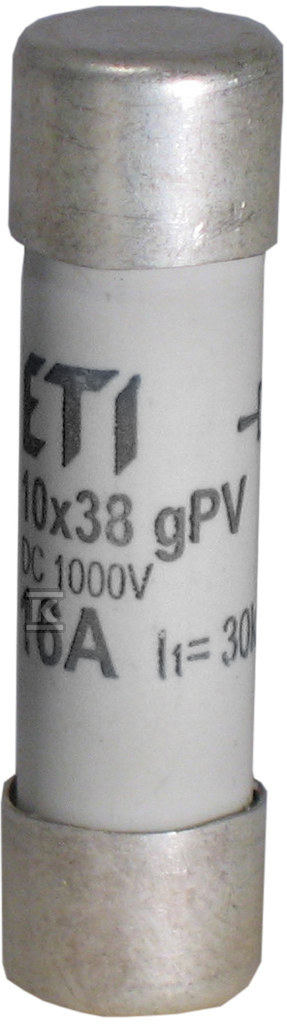
Cylindrical fuse link PV CH10X38 GPV 25A/900V DC 002625109

Suggested products
TECHNICAL DATA
Sales unit dimensions and weight: 1 pcs
Cylindrical fuse link PV CH10X38 GPV 25A/900V DC 002625109
Cylindrical fuse link CH10x38 gPV 25A/900V DC is a protective element dedicated to photovoltaic installations. It provides protection against overload and short circuit in DC circuits, protecting sensitive PV system components. Its compact dimensions – 10x38 mm – allow for easy integration with existing infrastructure.
Characteristics and application
The fuse link is characterized by a gPV characteristic, which means it is optimized for operation in photovoltaic installations. This specific characteristic allows for a quick response to short-circuit currents, minimizing the risk of damage, while also tolerating short-term current surges that occur during device startup. The rated current of 25A at 900V DC makes it an ideal choice for protecting photovoltaic modules and other elements of the system.
Key features and benefits
- PV installation protection: Designed specifically to protect DC circuits in photovoltaic systems.
- gPV characteristic: Fast response to short circuits, ensuring system safety and reliability.
- High short-circuit interrupting capacity: The DC short-circuit interrupting capacity is as high as 30 kA, guaranteeing effective protection even in the event of serious failures.
- Low power loss: Power loss is only 1.65 W (at 0.7xIn), which translates to minimal energy losses in the system.
- Compliance with standards: Meets the requirements of IEC 60269-6 standard, confirming its quality and safety of use.
- Compact dimensions: Dimensions of 10x38 mm facilitate installation and integration with existing infrastructure.
- Total Joule integral: High value of the pre-arcing (125 A²s) and total energy let-through (289 A²s) indicates high durability and ability to absorb energy during a short circuit.
It is important to select the correct fuse link for the parameters of the photovoltaic installation – a current rating that is too low will cause unjustified shutdowns, and a current rating that is too high will result in a lack of protection in the event of a failure.