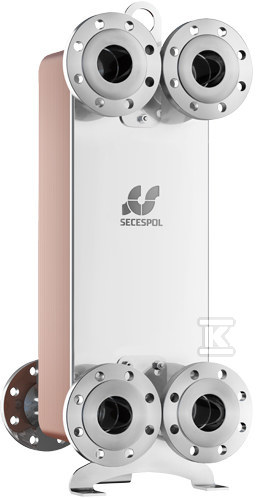
Brazed double-pass plate heat exchanger LD235-60L-2S-DN80SS (connections: 6 stainless steel flanges) 0255-0412

Suggested products
TECHNICAL DATA
Sales unit dimensions and weight: 1 pcs
Brazed double-pass plate heat exchanger LD235-60L-2S-DN80SS (connections: 6 stainless steel flanges) 0255-0412
Application and Performance in Demanding Conditions
This brazed plate heat exchanger is a solution dedicated to installations requiring high performance while maintaining tightness and resistance to extreme operating parameters. Thanks to its two-pass construction (denoted by 2S in the model name), the device offers an increased heat transfer surface area, which is crucial in heating and cooling systems with more demanding parameters. The optimal shaping of flow channels enables a high heat transfer coefficient while maintaining low flow resistance. This is important not only for energy efficiency but also for preventing the accumulation of contaminants inside the channels, thereby extending the service life of the installation.
The device performs well in both heating circuits (C.O.) and cooling or technological systems. Its construction allows operation with liquids at temperatures up to 230 °C and at a working pressure of up to 30 bar. Such thermal and pressure resistance makes it a suitable choice for heat pumps, chiller units, and advanced ventilation systems. The tightness of the entire structure is guaranteed by the vacuum brazing process, which permanently joins the stainless steel plates, eliminating the risk of micro-cracks typical of other joining methods.
Construction, Installation, and Corrosion Resistance
A key element of this model is the construction material – stainless steel, which provides high corrosion resistance compared to standard copper-brazed heat exchangers. This is important when working with aggressive working fluids or in environments with increased humidity. The heat exchanger features stainless steel flanged connections (6 pieces), facilitating installation in large industrial or commercial installations. The nominal diameter DN 80 on both sides (primary and secondary) allows for the flow of large quantities of fluid without the need for additional reducers or constrictions.
It is worth noting the compact dimensions of the device, which, despite its high thermal power, occupy relatively little space: the height is 788 mm and the width 310 mm. Such a design allows for easy integration of the heat exchanger into existing technical cabinets or boiler rooms with limited space. Simple installation and potential disassembly result from the logical construction and standard flanged connections. Additionally, the device is adapted for installation in thermal insulation jackets ("Suitable for insulation jacket: yes"), which allows for minimizing heat or cold losses directly at the heat exchanger, increasing the overall system efficiency.
Compliance with Standards and Versatility of Applications
The product has been manufactured in accordance with rigorous international standards, such as PED (Pressure Equipment Directive), ASME, and UL, confirming its operational safety in professional installations. Thanks to this, it can be used not only in residential buildings but also in public facilities or production plants. The project's flexibility allows for the selection of single- or two-pass versions, as well as various connection types – here we have a version with stainless steel flanges, ideal where full chemical resistance of the connection material is required.
Thanks to the turbulent flow generated by the special geometry of the plates, the heat exchanger achieves high performance even with smaller temperature differences between the fluids. This makes it an efficient element for modernizing existing systems or a new heart for newly designed high-class installations. The permanent joining of the plates eliminates the need for regular tightening of screws or mechanical seals, resulting in lower maintenance costs throughout the device's lifecycle. It is worth remembering its resistance to pressure and temperature changes and the possibility of operation in conditions requiring high durability of steel materials instead of traditional copper alloys.
CERTIFICATES, APPROVALS, SAFETY, COMPLIANCE AND WARNINGS
Certificate