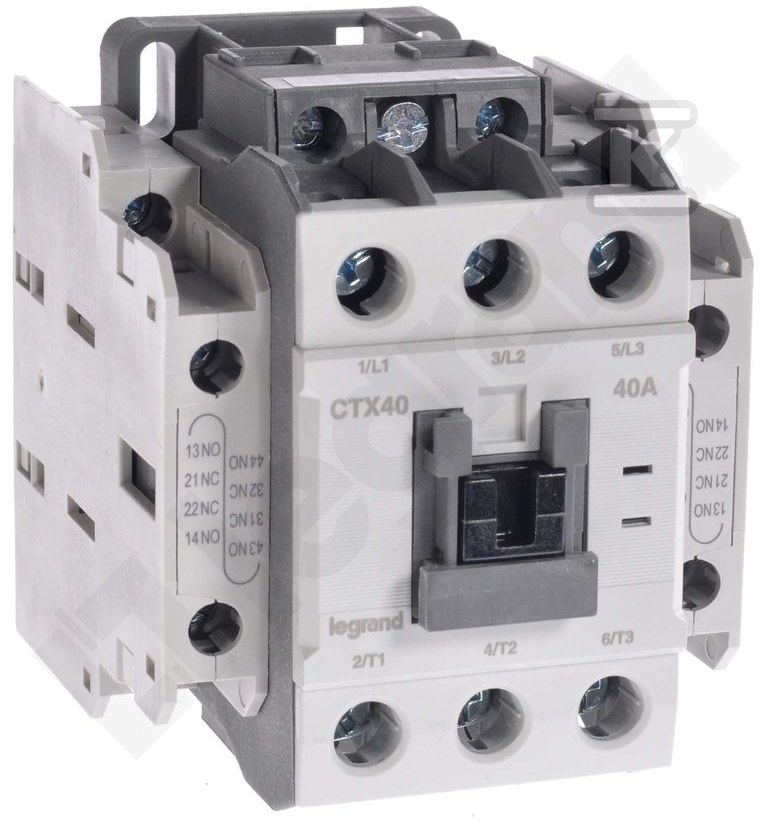
Contactor CTX3 3P 40A 2NO2NC 230V AC 416136

- 3414970400574
Suggested products
TECHNICAL DATA
Sales unit dimensions and weight: 1 pcs
Contactor CTX3 3P 40A 2NO2NC 230V AC 416136
Purpose and Application Possibilities
The three-pole electromagnetic CTX³ with an operating current of 40 A (AC-3 category) is designed for switching electrical circuits - primarily cage motors as well as lighting and heating circuits. The rated power at 400 V reaches 18.5 kW, allowing it to handle high-power drives directly from a standard distribution board.
The device performs well in both industrial applications (production lines, pumps, fans) and building installations requiring reliable control of main circuits. For resistive loads (AC-1), it can operate with currents up to 60 A, while heavy-duty AC-4 mode (e.g., motor jogging) allows power up to 7.5 kW at 17 A.
The control coil operates at 230 V AC. The manufacturer specifies the permissible supply range at 195.5-253 V, which means solid resistance to network fluctuations - particularly important in industrial facilities where voltage dips or surges are not uncommon. The contactor operates correctly at both 50 Hz and 60 Hz line frequencies.
Built-in auxiliary contacts in the configuration 2 normally open (NO) + 2 normally closed (NC) enable connection of status signaling systems, interlocks, or additional control circuits - without the need to mount external modules.
Mechanical Construction and Operating Parameters
The housing with a width of 80 mm contains three main poles and a full set of auxiliary contacts. The construction is designed for mounting on DIN TH35 rail - the standard profile used in distribution boards worldwide.
Main contacts are made as cable clamp terminals - connected by screws, which ensures durable contact for both solid and stranded wires with ferrules or bootlace pins.
The difference between AC-3 and AC-4 is crucial when selecting: AC-3 mode is typical continuous motor operation (switching without resistance), while AC-4 accounts for jogging operations - repeated switching under momentary load.
| Category | Current [A] | Power at 400 V [kW] |
|---|---|---|
| AC-1 | 60 | - |
| AC-3 | 40 | 18.5 |
| AC-4 | 17 | 7.5 |
CTX³ Series Expansion Accessories
The series offers a wide range of accessories to customize the device for specific applications:
RTX3 thermal overload relays - mounted as motor overcurrent protection; they cooperate with the contactor directly on the DIN rail or as a separate module.
Additional auxiliary contact blocks - when two normally open and two normally closed contacts are not enough; modules are installed on the front of the contactor without affecting the main construction.
Timer modules - allow delayed switching on or off; useful e.g., for star-delta starting or sequential device activation.
Damping resistor block - dedicated to commutation of power factor correction capacitor banks; a standard contactor without this module should not be used for capacitive switching due to current surges.
CTX3 mechanical interlock - prevents simultaneous engagement of two contactors; used e.g., in reversing circuits (motor rotation direction change) or power source switching.
Typical configurations: a reversing circuit requires two CTX³ contactors + mechanical interlock + thermal overload relay selected for motor power. Star-delta starting is implemented with three contactors: main and two switching the windings; here too, the timer module responsible for the switching sequence proves useful.
Standards, Documentation and Operating Conditions
CTX³ series contactors comply with IEC/EN 60947-1 (general requirements for switchgear and controlgear) and IEC/EN 60947-4-1 (specific standards for devices for motor communication).
The manufacturer provides complete technical documentation: assembly instruction LE07229AB and technical data sheet F01989EN containing dimensional specifications needed for switchgear design.
The housing is not sealed (no specified IP rating), so installation should be carried out inside control cabinets or dry distribution boards - humidity and dust above standard levels may affect the durability of internal electrical connections.
CERTIFICATES, APPROVALS, SAFETY, COMPLIANCE AND WARNINGS
Declaration of Conformity
Information about websites
Attachments