At Onninen, as experts in the installation industry, we often receive questions regarding the differences between emergency lighting and evacuation lighting. Although these terms are often used interchangeably, they actually represent different concepts within a building's safety system. From our many years of experience, we know that a proper understanding of these differences is crucial for installers planning lighting systems.
Emergency lighting is a broad term that encompasses all lighting systems activated during a failure of the primary power supply. In contrast, evacuation lighting is a specialized part dedicated to the safe exit from a building. In Onninen's assortment, you will find a full range of emergency fixtures from renowned manufacturers, tailored to every type of installation.
According to the applicable standard PN-EN 1838:2005 and technical regulations, every system must meet specific time and light parameters. Our technical advice will help you choose optimal solutions for a specific facility.
Check emergency fixtures at Onninen warehouse
What is the difference between emergency lighting and evacuation lighting
Emergency lighting is a general term that includes all systems providing light during a loss of primary power supply. In practical installation, we divide it into two main categories: backup lighting and evacuation lighting.
Backup emergency lighting
This is used in rooms where it is necessary to continue or safely finish work after the primary lighting fails. Examples of applications include:
- Operating rooms in hospitals
- Dispatch centers and control rooms
- Production lines in industry
- Research laboratories
Evacuation lighting as part of the emergency system
Evacuation lighting is a specialized part of the emergency system, whose main goal is to ensure safe evacuation from the building. In our offer, you will find complete evacuation solutions, including directional fixtures and lighting fixtures with various light characteristics.
| Parameter | Backup emergency lighting | Evacuation lighting |
|---|---|---|
| Operating time | Tailored to needs (min. 1h) | Minimum 1 hour |
| Light intensity | Compliant with work requirements | 1 lx for evacuation routes |
| Main application | Continuation of processes | Safe evacuation |
| Activation time | Up to 15 seconds | Up to 5 seconds (50% power) |
Where to use evacuation lighting – legal requirements
According to the regulation of the Minister of Infrastructure, emergency evacuation lighting is mandatory in certain types of facilities. From our experience in installation projects, we find that we most often install it in:
Public utility buildings
- Rooms over 2000 m² in office buildings
- Conference rooms and auditoriums for over 200 people
- Shopping centers and galleries
- Auditoriums of cinemas, theaters, and performance halls
- Exhibition rooms in museums
Industrial and warehouse facilities
We recommend our hermetic LED emergency fixtures with an IP65 protection rating, ideal for harsh industrial conditions. They are characterized by high resistance to dust and moisture and a long battery life.
Evacuation routes requiring lighting
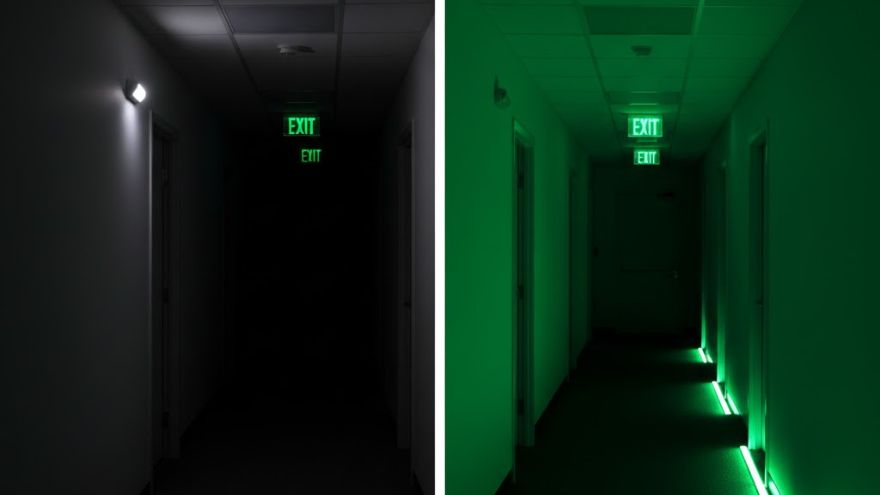
- Corridors lit only by artificial light
- Stairwells in high-rise buildings
- Tunnels and underground passages
- Evacuation routes in hospitals
Technical parameters and installation requirements
When designing emergency lighting systems, our specialists pay attention to key technical parameters specified in the PN-EN 1838 and PN-EN 50172 standards.
Time and light requirements
The evacuation lighting system must activate within 5 seconds of power loss, reaching 50% of the required intensity. After 60 seconds, it reaches full power - 100% of nominal parameters. The minimum lighting intensity is:
- 1 lx - for evacuation routes
- 0.5 lx - for open areas (anti-panic lighting)
- 15 lx - for high-risk areas
Emergency power supply technologies
In our assortment, we offer fixtures with various emergency power supply systems. The most commonly used solutions are:
Autonomous systems
Each fixture has its own lithium-ion batteries providing operational independence. The advantages of this solution include:
- Ease of installation
- Independence of individual light points
- Possibility of individual testing
- Ease of maintenance
Central systems with battery
One emergency power supply point for a larger group of fixtures. We recommend them in large facilities due to:
- Centralized maintenance
- Possibility of monitoring the entire system
- Cost-effectiveness in larger installations
- Advanced diagnostic functions
Modern technologies in LED fixtures
The emergency lighting industry is rapidly evolving towards LED technology. From our experience, more and more customers appreciate the advantages of modern LED fixtures:
Advantages of LED technology in emergency lighting
- Long lifespan - up to 40,000 hours of operation
- Low energy consumption - extending battery operation time
- Immediate activation - no startup time
- Resistance to frequent switching
- Stability of light parameters
Self-test functions and monitoring
Modern fixtures from our offer are equipped with advanced diagnostic functions:
- Automatic functional test - daily readiness check
- Full periodic test - verification of battery operation time
- LED signaling - information about technical status
- Address modules - integration with BMS systems
Selection of fixtures for specific applications
Our team of experts regularly advises on the selection of optimal solutions for various types of facilities. The solutions we most often recommend include:
Corridor fixtures
Dedicated to long, narrow communication spaces. They feature special corridor optics that provide even lighting along the entire length of the evacuation route.
Fixtures with open optics
Used in larger rooms and open areas. They provide wide light dispersion, minimizing the risk of panic during evacuation.
Hermetic IP65 fixtures
We particularly recommend them in industrial environments where high resistance to external factors is required. Ideal for production halls, warehouses, and outdoor facilities.
| Fixture type | LED power | Operating time | Application |
|---|---|---|---|
| Compact 1W | 1W | 1-3h | Small office rooms |
| Standard 3W | 3W | 1-3h | Corridors, stairwells |
| Industrial 6W | 6W | 1-3h | Halls, warehouses |
| Linear LED | 18-58W | 1.5-3h | Long corridors, tunnels |
Frequently Asked Questions
1. Is emergency lighting the same as evacuation lighting?
No, they are different systems with different functions. Emergency lighting is a general term that includes all lighting systems activated during a power failure. Evacuation lighting is its specialized part dedicated to the safe exit from a building.
2. How long must evacuation lighting operate?
At least 1 hour according to regulations. Most fixtures from our offer provide operating times from 1 to 3 hours, depending on battery capacity and LED power. Central systems can operate much longer.
3. Where is it mandatory to install evacuation lighting?
In facilities where the loss of lighting may threaten human life. This applies to rooms over 2000 m² in public utility buildings, rooms for over 200 people, auditoriums, museums, and all evacuation routes in high-rise buildings.
4. What light parameters must evacuation lighting meet?
Minimum 1 lx on evacuation routes according to the PN-EN 1838 standard. The system must activate within 5 seconds, reaching 50% power, and after 60 seconds, full power. Open areas require 0.5 lx, and high-risk areas require 15 lx.
5. Are LED fixtures better than traditional fluorescent ones?
Yes, LED technology offers significant advantages. LED fixtures have a lifespan of up to 40,000 hours, low energy consumption extending battery operation time, immediate activation, and stability of light parameters throughout their lifespan.
6. How often should the emergency lighting system be tested?
Monthly functional test, annual full periodic test. Modern fixtures with self-test functions automatically perform daily tests and signal any faults via an LED. This significantly facilitates system maintenance.
7. Which fixtures to choose - autonomous or central?
It depends on the size and type of the facility. We recommend autonomous systems for smaller facilities due to ease of installation. Central systems work well in large buildings, offering centralized maintenance and advanced monitoring of the entire installation.
Comprehensive safety solutions at Onninen
As a market leader in the installation industry, we offer not only the highest quality emergency fixtures but also comprehensive technical support at every stage of the project. Our team of experts will help you select optimal solutions considering the specifics of the facility and legal requirements.
In our offer, you will find products from renowned manufacturers: Awex, Eaton, RP-Technik, and Batertech. Each brand offers reliable solutions with various parameters, allowing you to choose optimal products for specific applications. All fixtures have the required CNBOP-PIB certificates and hygiene approvals for specialized applications.
Our network of branches throughout Poland ensures quick availability of products and local technical support. With many years of experience in installation projects, we can guarantee the highest quality solutions and professional advice at every stage of the investment. By investing in lighting fixtures from our offer, you ensure the safety of building users and compliance with applicable regulations.