Are you planning to replace the radiator in your bathroom? You need to know that the way it is connected to the installation will affect its performance, user comfort, and aesthetic qualities. That’s why we have prepared a guide in which we discuss the most popular types of bathroom radiator connections: bottom, side, and cross connections. You will also find practical installation tips for both DIY enthusiasts and professional installers.
Check out bathroom radiators at Onninen wholesale
Side connection – a traditional and minimally invasive solution
One of the most popular types of bathroom radiator connections in traditional buildings is the side connection. On one side of the radiator, either left or right, there are inlet and outlet pipes for water. On the inlet pipe for the heating water, there are valves with a thermostatic head. The side connection is often used in older bathrooms when replacing just the radiator without a complete renovation. It allows avoiding modernization of the existing installation - breaking walls and replacing pipes.
Cross connection – optimal for long bathroom radiators
In spacious bathrooms, long radiators are often installed, for which the cross connection works great, ensuring an even temperature distribution. The radiator distributes heat across its entire surface. With a cross connection, the supply water is brought in from the top, and the return water is drained from the bottom on the opposite side. The cross connection, like the side one, allows avoiding invasive pipe replacement. It is often used when replacing old cast iron radiators with more modern steel or aluminum models.
Bottom connection – a popular option in modern bathrooms
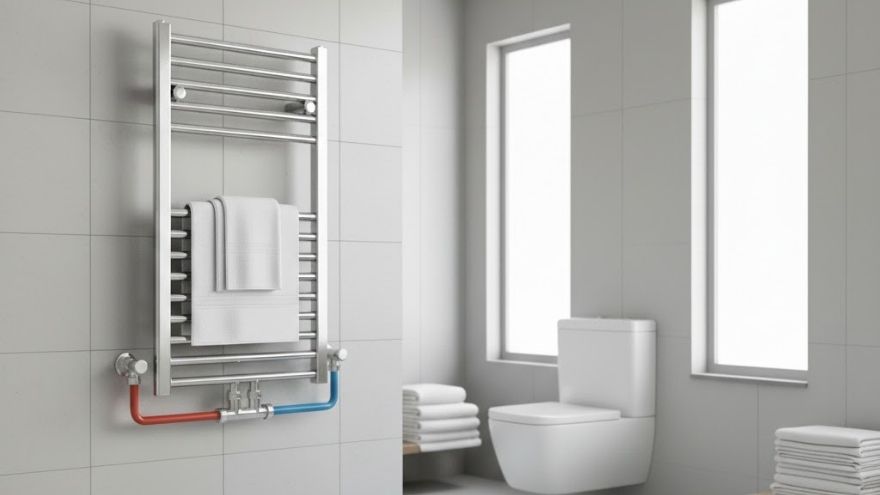
With the commonly used bottom connection in modern construction, the pipes supplying and draining water are located under the radiator, usually on the right side, but they can also be placed on the left side or in the center. This solution is valued for its aesthetic qualities – it effectively hides the installation elements. In this way, ladder bathroom radiators are often connected, mounted close to the floor, while longer radiators are rarely used due to the risk of uneven temperature distribution.
How to choose the best way to connect a bathroom radiator?
The type of connection for a bathroom radiator should be matched, among other things, to:
- the type of heating installation – in older systems, the side connection works well, while in modern installations with pipes hidden in the floor or wall, the
 bottom connection is often recommended;
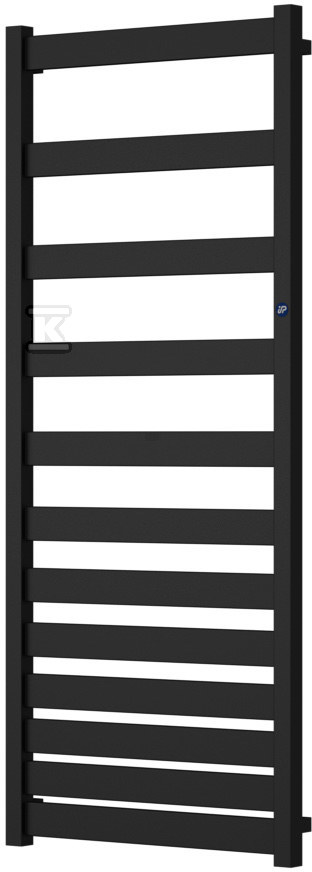
 - the type of radiators – for popular ladder radiators in contemporary bathrooms, as well as for long aluminum radiators, the central bottom connection is typically used due to its minimalist appearance and effective temperature distribution.
Radiators and bathroom equipment at Onninen plumbing wholesale
Are you planning a bathroom renovation – private or for a client? Check out bathroom equipment available at Onninen plumbing wholesale and order all the necessary solutions for your project: from radiators and installation elements to ceramics and fittings, as well as installation products and bathroom accessories.
Don’t know which radiators from our offer to choose or how to connect them? Contact us! Onninen technical sales advisors will be happy to help.
FAQ
What types of bathroom radiator connections are there?
For bathroom radiators, cross, bottom, or side connections are used. These are the three most popular types.
Which type of bathroom radiator connection is the most efficient?
The cross connection is considered the most efficient. It provides the most even flow and uniform heat distribution – especially with long panel and decorative radiators. With a cross connection, the radiator gives off more heat than with side and bottom connections.
Where to install a radiator in the bathroom?
The optimal choice is places where the greatest heat losses are recorded, e.g., the wall under the window. It is important that the radiator is located on an exposed wall. Enclosing it will significantly reduce its efficiency.
How to connect a bathroom radiator to an older type of installation?
If you want to use the existing installation, it is often necessary to choose the side connection for the radiator. However, it should be noted that it does not provide as discreet an effect as the bottom connection, which allows for aesthetically hiding the pipes.
What type of bathroom radiator connection is the most popular?
Currently, the bottom connection is most commonly used, especially the central bottom connection, which allows for discreetly hiding installation elements and is convenient to install.