The use of metal anchors for securing elements in concrete or brick is standard on construction sites and during renovation work. Metal anchors allow you to create reliable and permanently joined structures. Although anchoring seems quite simple, in practice, errors and oversights often occur. They can lead to serious consequences: from damaging materials, through breaking the connection, to endangering the safety of the entire structure and its users. Learn about the cardinal sins committed when using metal anchors and how to avoid them.

Check out the steel anchors at the Onninen wholesaler
The right choice of anchors – the foundation of a solid attachment
Choosing the right type of anchor is the first and most important step towards a reliable and durable fixing . We can distinguish mechanical anchors (also known as metal anchors or steel anchors , because they are mainly made of stainless steel or galvanized carbon steel) and chemical anchors . A metal anchor is an irreplaceable solution in construction. It provides reliable and durable fixing of heavy elements in various substrates. It is a much stronger alternative to an expansion bolt, which works well in lighter installation tasks, such as mounting wall decorations, shelves, etc.
The selected metal anchors must be precisely matched to the specific nature of the substrate and the planned load .
· For extremely durable and stable assembly of elements in concrete and solid brick, ideal 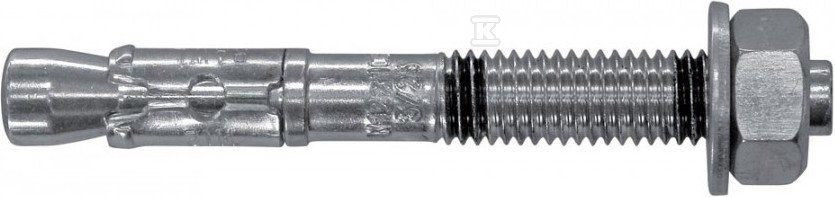 hammer anchors are suitable. They are perfect for structures exposed to heavy loads.
· In order to securely fasten elements in concrete and solid brick, e.g. when installing fences and steel structures, it is worth using expansion anchors equipped with expansion mechanism.
· A metal anchor works best in a dry, solid substrate, such as concrete. In the case of demanding, less dense substrates, special anchors for hollow blocks and aerated concrete provide the required stability.
Failure to match the mechanical anchor to the type of substrate and load may result in a lack of stability and rapid breakage of the fastening. The manufacturer decides on the intended use of a given anchor model, providing appropriate information on the packaging, in the technical description on the website or in the attached documentation. Most metal anchors available on the market are intended for anchoring in solid and dry substrates, in which they are able to achieve the highest load-bearing capacity, such as concrete and brick. Anchoring in hollow, masonry, damp, and unstable substrates requires the use of a metal anchor, the manufacturer of which explicitly allows such use. In the case of fastening very heavy (several hundred kilograms) structural elements in difficult conditions, e.g. in old, cracked concrete, ceramic blocks or aerated concrete, the use of a chemical anchor or a special-purpose anchor should be considered.
Drilling and cleaning the hole – precision is the priority
To install a metal anchor in the substrate, it is necessary to drill a hole. At this stage, mistakes are easy to make. The main sin is a hole that is too small or too large. An incorrectly sized hole prevents the anchor from expanding properly or causes play. One of the common mistakes that significantly reduces the load-bearing capacity is a hole that is too shallow. This can cause the anchor to slip out. However, drilling and installing the anchor at the wrong angle is associated with the risk of the element being torn out.
In summary, the hole should be perpendicular to the surface and have a depth and diameter consistent with the anchor manufacturer's recommendations.
When drilling, it is very important to use the right power tools. For drilling holes in hard surfaces such as concrete and solid brick, use a hammer drill and drill bits dedicated to the material.
After preparing the hole, it must be thoroughly cleaned of dust and other impurities. Otherwise, the anchor will not adhere well to the walls. Skipping this step threatens the durability of the entire structure!
Installation of metal anchor - always in accordance with its type and manufacturer's instructions
Different types of metal anchors require different installation techniques. For example, screw-in anchors are placed in holes and screwed in. At this stage, you need to make sure that the tightening is neither too strong nor too weak. A torque wrench allows you to control the tightening torque. In addition, you should not place the anchor very close to the edge or in the cracked concrete zone. After installing the anchor, it is worth carrying out a basic inspection. Regardless of the above recommendations, you must follow the manufacturer's guidelines for the purchased anchor. Remember that there is no room for compromise in construction!
At the Onninen electrical wholesaler, professionals can find a wide range of metal anchors for fastening elements in various types of substrates. We focus on products that meet the highest quality and safety standards and are characterized by high durability, versatility of use and ease of installation. We offer anchors from leading manufacturers of fastening systems, such as Koelner, Rawlplug and Walraven. Our technical and sales advisors will assist you in selecting fastening elements.