Depending on the specifics of the system, installations are equipped with various variants of contactors - solutions that allow for convenient control of systems and installations. They can also be responsible for switching on and off devices operating in the facility. What types of contactors are currently used?
Basic divisions of contactors into types
Contactors come in various versions. Depending on specific parameters, certain product groups can be distinguished. Depending on the type of current, AC contactors are distinguished, which can be used in 230 V and 400 V networks. These models are installed in power networks. The second version is DC contactors, used in low-voltage networks.
There are two types of contactors based on their application. The first group includes power contactors, which allow for the control of electric motors, as well as lighting and heating. Thanks to their design, they are adapted to operate with high current. The second group includes so-called auxiliary contactors. They are designed to operate with low current. For this reason, they are mainly used in industrial automation.
Another criterion is the number of available current paths. In single-phase systems (230 V), single-phase contactors 1P and 2P are used, while in three-phase systems — 3P and 4P, designed for networks supporting three-phase devices. Examples here are, among others, heating systems and three-phase motors.
Depending on the control method, electromagnetic and semiconductor contactors are distinguished. The former are controlled by an electromagnetic coil, while the latter, also called thyristor contactors, have no moving parts, are more durable and operate faster.
Depending on your specific needs, you can choose contactors with additional functions. Some models are equipped with additional protection, such as surge protection or mechanical locking.
Check out the offer of contactors at the Onninen wholesaler
What types of installation contactors are there?
Installation contactors are a wide range of products, including solutions dedicated to use in building installations and automation. The types of contactors mentioned earlier can be further divided into more detailed groups in the context of use in installations, e.g. the criterion of current paths includes single, two, three and four-pole models.
Depending on their function and application, the following are distinguished:
- bistable contactor , allowing for energy saving, maintains the on state after a short control pulse;
- quiet, soundless contactors which, due to the lack of noise when switching, are ideal for use in residential buildings;
- Contactors with mechanical locking, which are used in systems with two circuits, block the simultaneous activation of one of them.
Additionally, the group of installation contactors includes a number of classic solutions that allow for the control of lighting or heating, among others.
Due to the method of installation, a modular and panel contactor is distinguished. The first one is installed on a DIN rail, mainly in electrical switchboards. In turn, the panel variant is intended for installation in electrical boxes or control housings.
Division of industrial contactors
Switching off circuits in industrial electrical installations allows for convenient and safe control of systems and processes. In such circuits, various types of contactors are used, e.g. for alternating and direct current, single, double, three and four pole, electromagnetic (electromagnet coil causes switching), as well as sparkless (semiconductor).
Depending on the application, the following are installed:
- modular contactors, mounted on DIN rail;
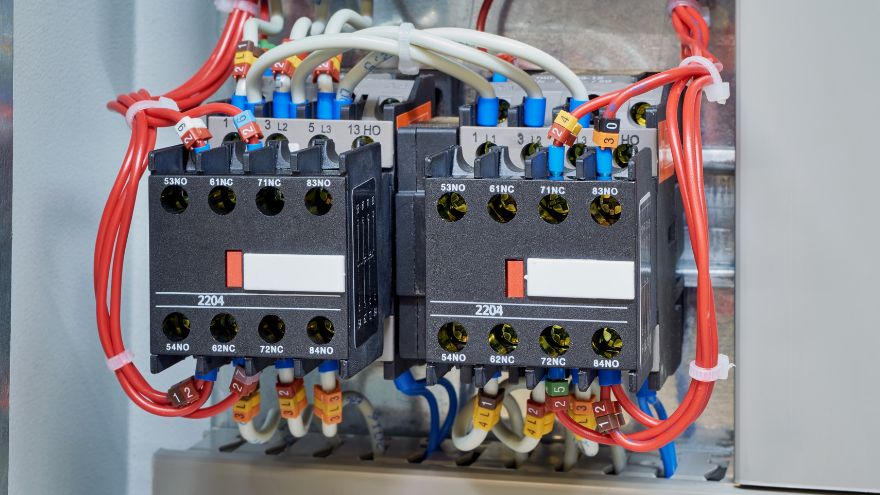
- reversing contactors, allowing the direction of motor rotation to be changed;
- auxiliary contactors, as auxiliary contacts, used to switch low-current circuits;
- power contactors, which are responsible for controlling high-power circuits, including motors, transformers, and HVAC systems.
Electrical contactors are used in home installations and advanced industrial systems. Depending on the installation location and the function of the system, different types of solutions are used. Specific parameters are important, including the contactor construction and operating parameters, such as voltage level, which determine the safety of the system and its proper functioning.