AC Residual Current Devices – why are they no longer sufficient?
AC residual current devices (RCDs) became standard in Poland over 20 years ago. Over these years, technical solutions have changed dramatically, as has the quantity and type of electrical devices in our homes. Ubiquitous electronics used in power supply systems for RTV/AGD equipment and consumer electronics pose new threats to users. These are related to the use of converter systems, which generate differential current with AC and DC components in the event of a failure. Eaton, anticipating regulations, responds to the changing nature of electrical installations in Poland. By ensuring safety and the highest quality standards, we enable the purchase of type A RCDs at a new, more attractive price.
What is the purpose of an RCD?
A residual current device (RCD) – commonly referred to as an "RCD" – is an electrical safety device that immediately interrupts the electrical circuit as soon as it detects a small leakage current (differential) indicating current flow to the ground. It is used in domestic installations as a supplementary means of protection against electric shock, protecting users from dangerous electric shocks (especially in the case of indirect contact) and reducing the risk of fire caused by leakage currents due to insulation damage. It should be emphasized that an RCD does not replace fuses or circuit breakers (MCBs), but complements their operation – detecting different types of hazards than they do.
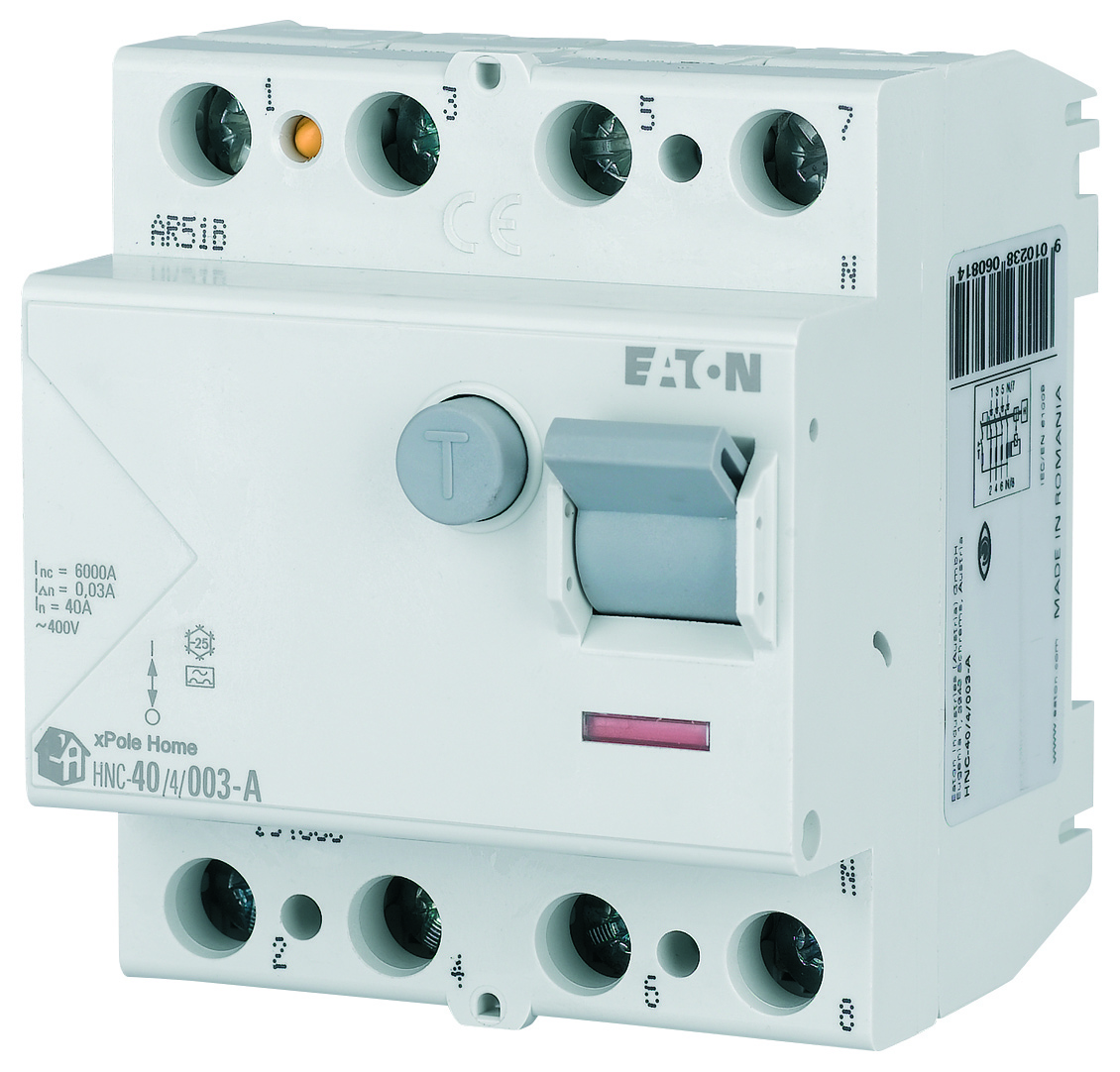
Type A residual current device, HNC-40/4/003-A
How does an RCD work?
A residual current device operates on the principle of measuring the differential current – the sum of currents entering and leaving the protected circuit – using a Ferranti transformer. Under normal operating conditions, the vector sum of currents in these conductors is zero, according to Kirchhoff's first law, so no EMF (electromotive force) is induced in the "Ferranti" core, and the trigger coil does not conduct current. In this situation, the RCD contacts remain closed.
However, if insulation damage or electric shock occurs – causing current to flow to the ground (through the PE conductor or the human body), the current leaving the circuit (e.g., from the phase) ceases to equal the current returning through the neutral conductor. When the value of the differential current exceeds the established threshold, e.g., 30 mA for a typical domestic RCD, the mechanism immediately opens the main contacts of the device, disconnecting the power supply to the protected circuit.
What types of RCDs does Eaton offer?
| RCD Type | Detected Differential Currents | DC Component Resistance | Typical Application | Notes / Limitations |
| AC | Sinusoidal AC | ❌ none | Simple resistive circuits (increasingly rare) | Not recommended in modern installations; may not operate with electronic devices |
| A | Sinusoidal AC + pulsating DC (half-wave, ≤ 6 mA DC) | ✅ partial | Standard in domestic installations (sockets, lighting) | Effective protection with alternating current and DC component |
| F | Like type A + currents with variable frequency (up to about 1 kHz), DC up to ~10 mA | ✅ extended | Circuits with single-phase inverters (inverter washing machines, 1-phase heat pumps) | Better resistance to DC component than types A and response to mixed frequencies |
| B | AC, pulsating DC, smoothed DC, currents at higher frequencies | ✅ full | PV, EV, converters, installations powered by converters | Required when a DC component is possible; most comprehensive |
What threats does damage to domestic electronics pose? What is a DC component?
The DC component in differential current is a constant leakage current over time. It typically appears in the event of damage to electronic devices (containing rectifiers or inverters), e.g., switch-mode power supplies, RTV/AGD equipment, PV inverters, or EV chargers. Such direct current causes magnetization of the core (Ferranti transformer) in the RCD, shifting its operating point. As a result, even significant AC leakage may not reach the tripping threshold due to the "blindness" of the RCD sensor – the device may not disconnect the power supply at the assumed current and time. For this reason, type AC (which only operates on a pure AC sine wave) is currently considered insufficient for most domestic and industrial applications. In modern installations, at least type A is recommended, which is also sensitive to pulsating DC currents (up to ~6 mA). However, with higher shares of direct current (above 6 mA), dedicated solutions are required – either type B RCDs.
What are the consequences of improper selection of an RCD?
Using the wrong type of RCD (e.g., AC instead of A/B) risks not disconnecting the power supply in the event of a fault (loss of protection against electric shock and fire). Using an RCD of too basic a type like AC in circuits with rich power electronics (e.g., inverters, power supplies) can result in numerous unwanted tripping of protections during normal operation of devices (RCDs react to the pulsations and higher harmonics present as if they were a fault). Types F and B have systems that limit these phenomena, ensuring both greater reliability of operation in the event of real danger and lower sensitivity to transient disturbances (interference filters, delays of 10–40 ms, etc.).
What do regulations and standards say?
More and more standardization organizations and energy companies recommend or even require the use of type A RCDs in domestic and industrial installations. For example:
- The IEC 60755 standard indicates that type AC may not be sufficient for many devices with nonlinear power supply.
- In Germany and Austria, there has been a ban on using type AC in new domestic installations for several years.
- In the UK, the IET (Institution of Engineering and Technology) recommends using type A in most circuits where electronic devices are present.
The most popular residual current devices[BJ1] from EATON
| Type AC | Type A | |||
| Execution | Cat No | Type | Cat No | Type |
| 25A 1+N 30mA | 194690 | HNC-25/2/003 | 194684 | HNC-25/2/003-A |
| 40A 1+N 30mA | 194691 | HNC-40/2/003 | 194685 | HNC-40/2/003-A |
| 63A 1+N 30mA | 194692 | HNC-63/2/003 | 194686 | HNC-63/2/003-A |
| 25A 3+N 30mA | 194693 | HNC-25/4/003 | 194687 | HNC-25/4/003-A |
| 40A 3+N 30mA | 194694 | HNC-40/4/003 | 194688 | HNC-40/4/003-A |
| 63A 3+N 30mA | 194695 | HNC-63/4/003 | 194689 | HNC-63/4/003-A |
Summary
AC residual current devices, although widely used in domestic installations for years, no longer fully meet the requirements of modern electrical systems. The increasing number of electronic devices, switch-mode power supplies, inverters, PV installations, or EV chargers means that in the event of a failure, differential currents with DC components may occur, which type AC does not reliably detect.
Therefore, in new and modernized installations, it is recommended to use at least type A RCDs, which provide more effective protection with contemporary energy receivers. In more demanding applications, such as photovoltaics, electric vehicle charging, or systems with converters, types F or B may be the appropriate choice. Eaton, responding to these technological changes and increasing safety requirements, promotes the wider use of type A RCDs, offering them at a more attractive price as the new standard of protection in electrical installations.
Author: Bartłomiej Jaworski, Field Product Marketing Manager at Eaton.