Vibration isolator DVA.2-8-8-M3-6-40 Z050102

Catalog numbers:
- DVA.2-8-8-M3-6-40
Suggested products
TECHNICAL DATA
Sales unit dimensions and weight: 1 pcs
Vibration isolator DVA.2-8-8-M3-6-40 Z050102
Vibration isolators – reduction of vibrations and noise
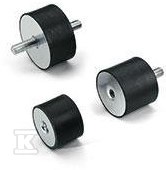
Vibration isolator DVA.2-8-8-M3-6-40 is a vibration damping element reducing noise, used in a wide range of devices and machines. It consists of a threaded pin and a molded insert with a threaded hole, made of galvanized steel. Its construction allows for effective isolation of elements sensitive to vibrations, which translates to increased work comfort, extended device life and improved safety.
Construction and application
This vibration isolator is characterized by a cylindrical structure. It has an external thread on the pin and an internal thread in the insert, which allows for easy assembly and disassembly. It is intended for applications where vibration isolation with low amplitude and frequency is required. Thanks to its construction, it is ideal for mounting elements such as motors, fans or pumps, minimizing the transmission of vibrations to the surroundings.
Key features and parameters
- Material: galvanized steel – provides strength and corrosion resistance.
- Diameter: 8 mm – standard size facilitating integration with various structures.
- Metric thread size: M3 – enables precise fastening.
- Shore hardness: 40 – provides optimal damping properties for many applications.
- Height: 8 mm - compact size allows for use in space-constrained areas.
- Connection 1: External thread - allows easy screwing into structural elements.
- Connection 2: Internal thread - ensures a stable connection with the mounted element.
It is worth remembering that versions with rubber of different hardness (55 and 70 Shore A) are also available, which allows you to adapt the damping properties to specific application needs. The choice of the appropriate rubber hardness affects the efficiency of vibration isolation and noise reduction. Higher hardness means greater stiffness and less ability to dampen low-frequency vibrations, while lower hardness provides better damping of higher-frequency vibrations.