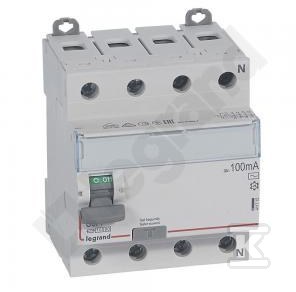
Residual current device P 304 4P 80 A 100 mA type AC, DX3 series 411715

Suggested products
TECHNICAL DATA
Sales unit dimensions and weight: 1 pcs
Residual current device P 304 4P 80 A 100 mA type AC, DX3 series 411715
Protection and Safety of Electrical Installations
The residual current device (RCD) P 304 4P 80 A 100 mA type AC from the DX3 series is a critical component ensuring safety in every electrical installation. Designed to protect people from electric shock and to safeguard circuits against the effects of short circuits and overloads, its primary function is to rapidly disconnect the power supply upon detection of earth leakage current, minimizing risks to users and equipment.
Construction and Specifications
This device features a four-pole design, providing protection for all phase conductors and the neutral. With a rated current of 80 A, it is suitable for protecting circuits with high power demand. The sensitivity to differential current of 100 mA ensures effective protection against electric shock. Installation is performed on a DIN rail, simplifying integration into existing electrical infrastructure. The device’s width of 4 modules allows efficient use of space in distribution boards.
Applications and Benefits
The P 304 DX3 RCD is suitable for both residential and industrial applications. It is ideal for protecting lighting circuits, socket outlets, and electrical equipment exposed to moisture or insulation damage. Thanks to its high breaking capacity (10 kA), the device effectively protects installations against the consequences of sudden voltage surges. Additionally, the lockout feature prevents accidental re-energizing after tripping. Constructed from high-quality materials, it guarantees reliable operation and long service life. The rated impulse voltage withstand of 4 kV provides additional safety in case of network overvoltages. The terminal accepts single-core conductors up to 50 mm² and multi-core conductors up to 35 mm², offering flexibility in selecting cables tailored to specific installation requirements.