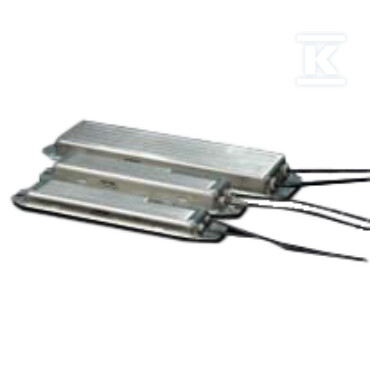
Resistors, dedicated for use with MCRA frequency inverters 100W 300 OHM MCRA 100W 300 OHM
Suggested products
TECHNICAL DATA
Sales unit dimensions and weight: 1 pcs
Resistors, dedicated for use with MCRA frequency inverters 100W 300 OHM MCRA 100W 300 OHM
Braking resistors for inverters – the key to efficient energy management
The MCRA 100W 300 OHM braking resistor is an element dedicated to working with frequency inverters, designed to safely dissipate energy generated during motor braking. Its task is to convert excess kinetic energy into heat, thereby protecting the inverter and ensuring stable system operation. This is particularly important in applications requiring frequent braking, such as cranes, lifts or industrial machines.
Construction and application
The MCRA 100W 300 OHM resistor is characterized by a compact design with dimensions of 150 x 35 x 19 mm, which facilitates mounting even in limited space. It has been designed specifically for use with LS Electric inverters, but can be used with other devices with similar parameters. Its resistance of 300 Ohm and power of 100W make it suitable for applications with motors up to approximately 3 kW (depending on the inverter specifications). Using a braking resistor allows for efficient energy utilization and reduced operating costs.
Features and benefits
- Dedicated to LS inverters: Ensures optimal cooperation and system performance.
- Compact dimensions: Allow for easy installation in tight spaces.
- Safe housing: Protects against accidental contact and ensures user safety.
- Effective energy dissipation: Prevents overheating of the inverter and extends its lifespan.
- Wide range of applications: Can be used in various industrial and domestic applications.
- High reliability: Ensures stable operation of the braking system for a long time.
- Environmental resistance: Designed to operate in a temperature range from -55°C to +200°C, with high electrical insulation (above 100 MΩ) and dielectric strength (AC 2,500V / 1 Min). Temperature coefficient of resistance is ±260 ppm/°C max.
This resistor is not only a safety element, but also affects the smoothness of mechanisms using regenerative braking – which translates into the precision and efficiency of the entire system. Thanks to this, installers can be sure that the system will operate reliably for a long time, and end users will appreciate the improvement in performance and safety of the devices.