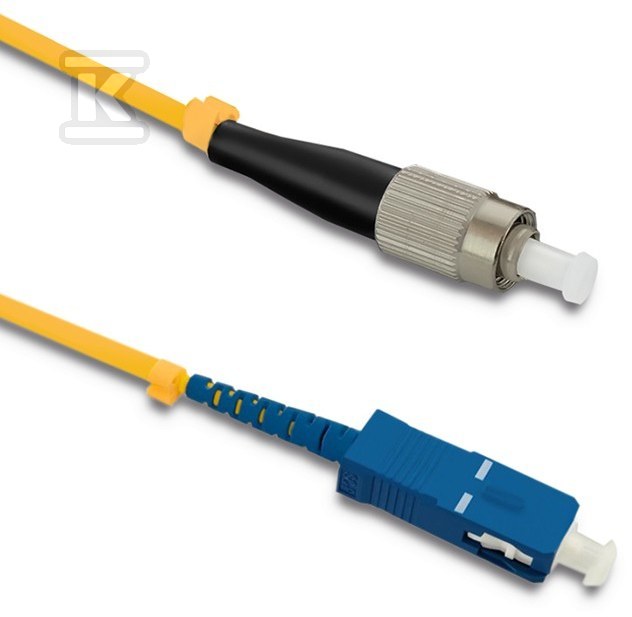
Fiber optic patchcord FC/UPC - SC/UPC Singlemode 9/125 G652D Simplex 0.5m 54314

Suggested products
TECHNICAL DATA
Sales unit dimensions and weight: 1 pcs
Fiber optic patchcord FC/UPC - SC/UPC Singlemode 9/125 G652D Simplex 0.5m 54314
Fiber optic patch cord FC/UPC - SC/UPC – reliability and transmission efficiency
This fiber optic patch cord is an ideal solution for building and expanding LAN, WAN, CCTV systems and telephone installations. It will work both in the office, home, and in industrial environments where stable and secure data transmission is required. It uses single-mode fiber 9/125 µm, compliant with the G652D standard, which guarantees high signal quality and minimal losses during data transmission over long distances.
Construction and application
The patch cord connects FC/UPC connectors to SC/UPC, ensuring compatibility with a wide range of network devices. The simplex construction means a single fiber in the cable, simplifying installation and configuration. A length of 0.5 meters is optimal for connections in rack cabinets or short network segments. It is worth mentioning the use of LSZH (Low Smoke Zero Halogen) coating – a non-flammable material that limits the emission of toxic gases in the event of a fire, increasing the safety of users and equipment.
Advantages of fiber optics – why is it worth it?
Choosing fiber optic cabling is an investment in the future of your network. Compared to traditional copper cables, it offers a number of benefits:
- Immunity to interference: Fiber optic is completely immune to electromagnetic interference, ensuring stable data transmission even in difficult environmental conditions.
- Security: The lack of sparking and the high voltage required for eavesdropping make transmission over fiber optic much safer than copper.
- High bandwidth: A single fiber optic fiber offers enormous information capacity, allowing you to transmit large amounts of data at high speed.
- Long distances: Low signal loss allows data to be transmitted over long distances without the need for signal amplifiers.
- Costs: Although the initial cost may be higher than copper cables, long-term operating costs are lower due to lower signal loss and greater reliability.