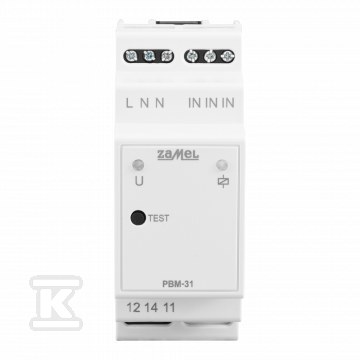
Bistable (pulse) relay switched at zero-crossing, 230V AC PBM-31 EXT10000303

Suggested products
TECHNICAL DATA
Sales unit dimensions and weight: 1 pcs
Bistable (pulse) relay switched at zero-crossing, 230V AC PBM-31 EXT10000303
Bistable relay for LED lighting control
The PBM-31 bistable relay is a solution designed to control lighting, especially LED, using pulses. Thanks to zero-voltage and zero-current switching technology, it allows direct connection of loads up to 1000W without the need for additional elements such as contactors or intermediate relays. This saves space and costs, and simplifies installation. The device is ideal for offices, warehouses, factories and anywhere where control of high inrush currents is required.
Functionality and application
The PBM-31 relay operates on the principle of pulse control – each button press changes the state of the relay (turns it on or off). The ability to connect multiple buttons in parallel eliminates the need for traditional stair and cross switches, simplifying wiring. This makes it easy to create "smart" lighting control systems. Zero-crossing switching technology minimizes electromagnetic interference (EMC) and extends the life of both the relay and the connected devices.
Advantages in practice
- Direct control of LED loads: Ability to connect up to 1000W of LED lighting without additional elements.
- Simplified installation: Eliminates the need for complex switching circuits.
- Reduced interference: Zero-voltage and zero-current switching reduces the formation of switching interference.
- Versatility: Ability to control various devices using pulses.
- Bistability: Maintains the on or off state without the need for continuous power to the control circuit.
- Ease of use: Intuitive operation with single-pole buttons.
- Optical signaling: Built-in LEDs indicate the status of the power supply and the relay state (red/green).
Installation and safety
The PBM-31 relay is mounted on a standard TH35 (DIN) rail. Before starting work, disconnect the power supply and ensure that the wires are de-energized. The connection of the wires should be made according to the diagram in the user manual. It is recommended to entrust the installation to a qualified electrician with appropriate qualifications (SEP 1kV). The device has a protection class of IP20, which means protection against accidental contact, but not against the effects of water.