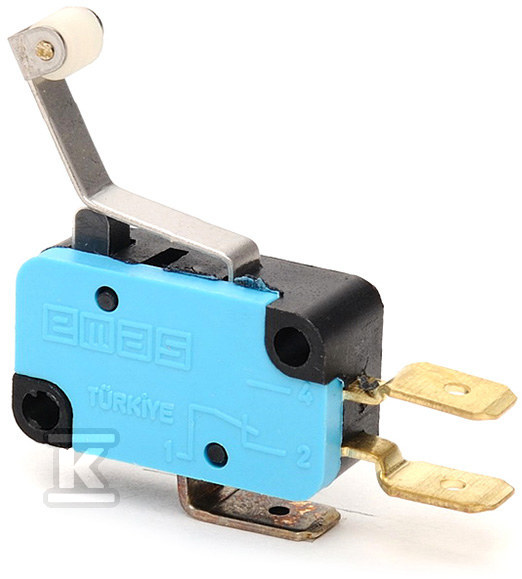
Microswitch, SPDT contact 1xCO, bent lever with plastic roller T0-MK1MIP3

Suggested products
TECHNICAL DATA
Sales unit dimensions and weight: 1 pcs
Microswitch, SPDT contact 1xCO, bent lever with plastic roller T0-MK1MIP3
Microswitch with lever and plastic roller – reliability in a compact housing
This single-pole single-throw (1CO) microswitch is a robust solution for precise control in a wide range of applications. Equipped with a bent lever with a plastic roller, it ensures smooth and reliable operation, minimizing the risk of mechanical damage. Designed for both industrial and consumer applications requiring high precision and durability.
Design and operating parameters
The microswitch has been designed for long-term operation. Made of flame-retardant V0 class plastic, it ensures safe use even in harsh conditions. Its solid construction guarantees resistance to mechanical damage and vibrations. The rated switching voltage is 250 V AC, and the switching current is 10 (4) A, making it a versatile choice for many electrical circuits. Insulation resistance at 10 MΩ (at 500 V DC) provides effective protection against short circuits and overvoltages.
Applications and benefits
This microswitch is perfect for applications requiring frequent switching, such as:
- Household appliances: Washing machines, dryers, dishwashers – control of the position of mechanical elements.
- Industrial automation: Control systems, robotics, production machines – precise position detection.
- Medical equipment: Diagnostic devices, laboratory equipment – reliable operation in critical applications.
- Automotive industry: Lighting control, safety systems – durability in demanding conditions.
- Alarm systems: Door/window opening sensors – quick reaction to events.
Thanks to its high mechanical (minimum 10 million operations) and electrical durability (minimum 100 thousand operations), the microswitch ensures long-lasting and trouble-free operation. Compliance with EN 60947-5-1 standard confirms its safety and quality. C characteristic allows it to react slower to short current surges, therefore it tolerates starting devices with a motor well. It protects the circuit against overload and short circuit — like most switches in this class.