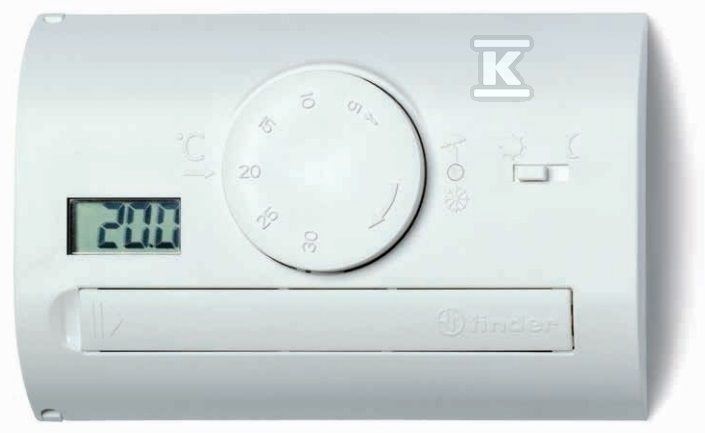
Electronic wall-mounted thermostat 1T.41.9.003.0000
Suggested products
TECHNICAL DATA
Sales unit dimensions and weight: 1 pcs
Electronic wall-mounted thermostat 1T.41.9.003.0000
Wall-mounted thermostat is a simple yet effective solution for temperature regulation in rooms. Model 1T.41.9.003.0000 from FINDER is a device designed for surface mounting, ideal for both new installations and modernization of existing heating systems. Its versatility makes it suitable for homes, apartments, offices and other facilities where precise temperature control is key.
Functionality and application
This thermostat allows you to set the desired temperature in the range of 5 to 37°C, ensuring thermal comfort and optimizing energy consumption. Thanks to battery power (2 x AAA 1.5V), installation is simple and does not require additional power cabling – which will be appreciated by both installers and end users. Equipped with control buttons, it offers intuitive operation and ease of programming. The display makes it easy to read the current and set temperature.
This thermostat is particularly useful in electric, radiator or water heating systems where temperature control is performed using relay contacts with a load capacity of 5A at 250V AC. The adjustable hysteresis (0.1…0.9 K) allows for precise adjustment of the thermostat's operation to the specifics of the installation and user preferences. Additionally, it has outputs for both heating and cooling - making it a versatile solution all year round.
Construction and parameters
The device is characterized by a compact design with dimensions of 110 x 73.3 x 22 mm and a protection class of IP20 – which means protection against touching with fingers and against the ingress of solid objects larger than 12.5 mm. Made of high-quality materials, it ensures durability and reliable operation for a long time. The NTC sensor guarantees accurate temperature measurement (+/- 0.5°C at +20°C). The thermostat also has a frost protection function (adjustable at +2…+8°C), which protects the installation from damage during low temperatures. The lack of an audible signal minimizes potential interference for users.