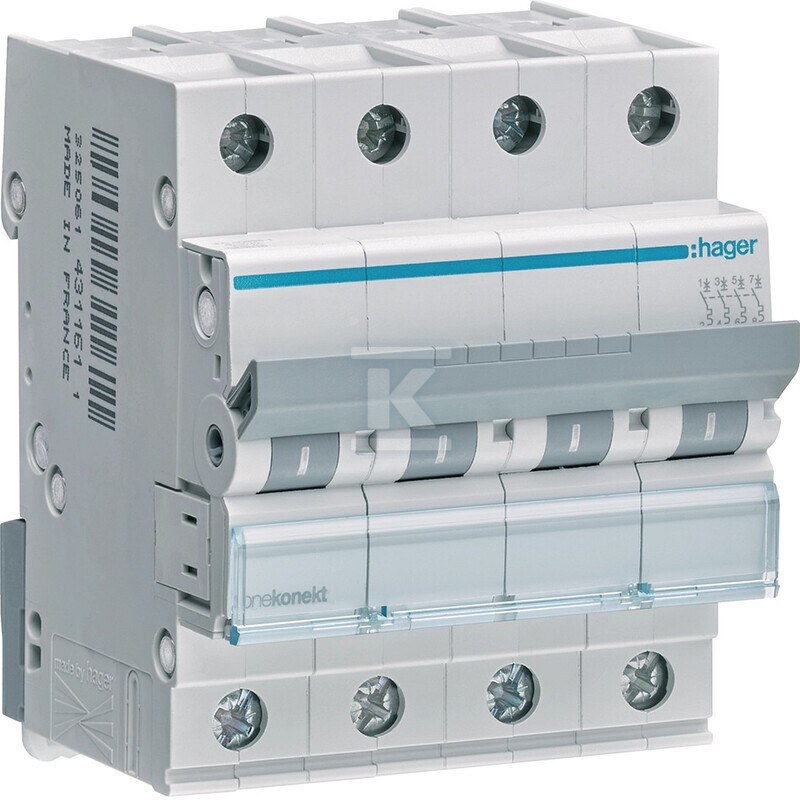
MCB Miniature circuit breaker Icn=6000A 4P C 25A MCN425

Suggested products
TECHNICAL DATA
Sales unit dimensions and weight: 1 pcs
MCB Miniature circuit breaker Icn=6000A 4P C 25A MCN425
Protection of three-phase circuits with C characteristic
The four-pole miniature circuit breaker MCN425 belongs to the family of miniature circuit breakers (MCB) used in modular DIN rail switchboards. The device protects three-phase circuits with a neutral conductor against the effects of overloads and short circuits - the delayed thermal trip reacts to long-term exceedances of the rated current, while the electromagnetic trip instantaneously interrupts the circuit in the event of a short circuit.
The C tripping characteristic means that the device will operate at a rated current multiplied by a factor of 5 to 10. In practice, at 25 A, it will operate in the range from approximately 125 A to approximately 250 A - therefore, this version is suitable for circuits with moderate inrush currents. These include, among others, electric motors, air conditioning units, compressors, and lighting installations with fluorescent lamps or LEDs with electronic power supplies.
The presence of four poles allows for the simultaneous disconnection of all three phases and the neutral conductor - which is important in installations requiring full isolation of the load from the network.
Breaking capacity and electrical parameters
The rated short-circuit breaking capacity is 6 kA according to the IEC 60898-1 standard (a value commonly found in standard residential and commercial building installations). For more demanding industrial applications, the manufacturer also specifies an Icu parameter of 10 kA at a voltage of 400 V AC according to IEC 60947-2 - this value defines the maximum short-circuit current that the device can safely interrupt and remain functional.
The operating voltage is in the range of 230-400 V AC, which covers typical three-phase network configurations. The insulation is rated for 500 V, and the impulse withstand voltage is 4 kV - the device will handle typical surges occurring in building installations.
The manufacturer also provides a table of rated currents as a function of ambient temperature - which is important information for installers working in switchboards with elevated temperatures. At +30°C, the device still operates at a full 25 A; at +40°C, it drops to approximately 23.5 A; while at +70°C, it reaches only about 18.3 A. In lower temperatures, it behaves inversely - at -15°C, it can safely operate at a current up to 30.5 A. This is worth remembering when selecting a circuit breaker for outdoor switchboards or technical rooms.
Connection and dimensions
The device occupies 4 modules of width on the DIN rail (70 mm). The upper terminals are screw connections - solid conductor from 1 to 35 mm², stranded wire from 1 to 25 mm². The bottom side uses the biconnect system, enabling faster installation via spring push-in terminals or traditional screw connection. The tightening torque is 2.8 Nm for both the upper and lower terminals.
The possibility of rotary mounting (360°) allows for flexible device placement even in tight switchboards. Additional equipment - such as shunt trips or undervoltage coils - can be installed without the need to replace the circuit breaker itself.
Power losses at full load are approximately 13.4 W, which is a typical value for four-pole designs of this class.
Operating conditions and environmental standard
The enclosure protection rating is IP20 - sufficient for indoor installation in closed switchboards; it is not intended for damp rooms or outdoor use without additional protection. The device operates correctly in a temperature range from -25°C to +70°C, and the manufacturer declares moisture resistance for all climate zones.
The pollution degree according to IEC 60664 / IEC 60947-2 is 2, which means typical indoor conditions without significant dust or chemically aggressive atmospheres.<
CERTIFICATES, APPROVALS, SAFETY, COMPLIANCE AND WARNINGS
Declaration of Conformity