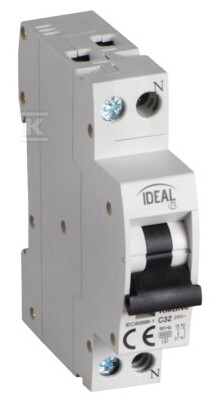
Overcurrent circuit breaker, 6kA, 1P+N KMBN6-C32/1 KANLUX IDEAL TS 32572

Suggested products
TECHNICAL DATA
Sales unit dimensions and weight: 1 pcs
Overcurrent circuit breaker, 6kA, 1P+N KMBN6-C32/1 KANLUX IDEAL TS 32572
Protection of electrical installations and devices
This single-pole overcurrent circuit breaker with neutral protection (1P+N) from KANLUX IDEAL TS is a reliable solution for protecting electrical circuits from the effects of overloads and short circuits. It ensures safety in home, commercial and industrial installations. Its compact design, taking up only one module on a TH35 rail, allows for efficient use of space in the distribution board.
Characteristics and application
The circuit breaker with C characteristic is particularly recommended for circuits with receivers generating inrush currents during start-up, such as motors, transformers or refrigeration units. Because it reacts with a delay to short-term current surges, it minimizes the risk of unnecessary tripping of the installation. The rated current of 32A makes it suitable for protecting circuits with medium power consumption. The rated voltage of 230/400V AC makes it a universal solution for most electrical installations in Poland.
Construction and parameters
The circuit breaker is designed in accordance with PN-EN 60898-1, which guarantees its high quality and safety of use. Its energy limitation class is 3, which means good ability to withstand short-circuit energy. The possibility of mounting on a TH35 rail facilitates installation and replacement of the device. A wide range of wire cross-sections (1÷25 mm²) ensures compatibility with various types of cabling. The degree of protection IP20 protects against finger contact, but does not provide protection against atmospheric conditions - the circuit breaker is intended for installation indoors at an ambient temperature of 5°C to 40°C. The rated insulation voltage Ui is 500V, which further increases safety. The rated short-circuit current is as high as 6kA, which proves its high resistance to the effects of short circuits.