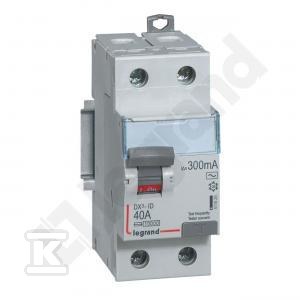
Residual current device P 302 2P 40 A 300 mA type AC, DX3 series 411525

Suggested products
TECHNICAL DATA
Sales unit dimensions and weight: 1 pcs
Residual current device P 302 2P 40 A 300 mA type AC, DX3 series 411525
Safety and Protection in Your Electrical Installation
The residual current device P 302 2P 40 A 300 mA AC from the DX3 series is a critical component ensuring protection of people and equipment in electrical installations. Its purpose is to rapidly detect and disconnect the circuit in the event of leakage currents, minimizing the risk of electric shock and preventing fires. This reliable protection performs reliably in both residential and commercial buildings.
Functionality and Applications
This two-pole (2P) device, rated at 40 A and with a sensitivity of 300 mA, is designed for operation in 230 V AC circuits. Its AC-type technology ensures effective protection against alternating leakage currents. This device is ideal for safeguarding lighting circuits, socket outlets in wet areas (e.g., bathrooms, kitchens), and electrical appliances exposed to moisture. It enhances usage safety and reduces the risk of failures.
Design and Installation
The P 302 DX3 features a compact design, occupying only 2 modules on a DIN rail, simplifying installation in electrical distribution boards. It includes a mechanical lock that prevents accidental re-energizing after tripping due to residual current operation. The connected single-core cable cross-section can range from 0.75 to 50 mm², and multi-core cables from 0.75 to 35 mm², ensuring flexibility in connecting various cable types. With a short-circuit withstand rating of 10 kA, it guarantees resistance to damage during installation faults. Additionally, the device features a test button enabling regular verification of its functionality—a simple step to confirm the protection operates correctly.
Note: Residual current devices from the DX³ series are compatible with the HX³ Optimal Energy Distribution System up to 125 A, enabling wireless connection to the electrical installation and integration with auxiliary equipment (auxiliary and signaling contacts, undervoltage and overvoltage releases).