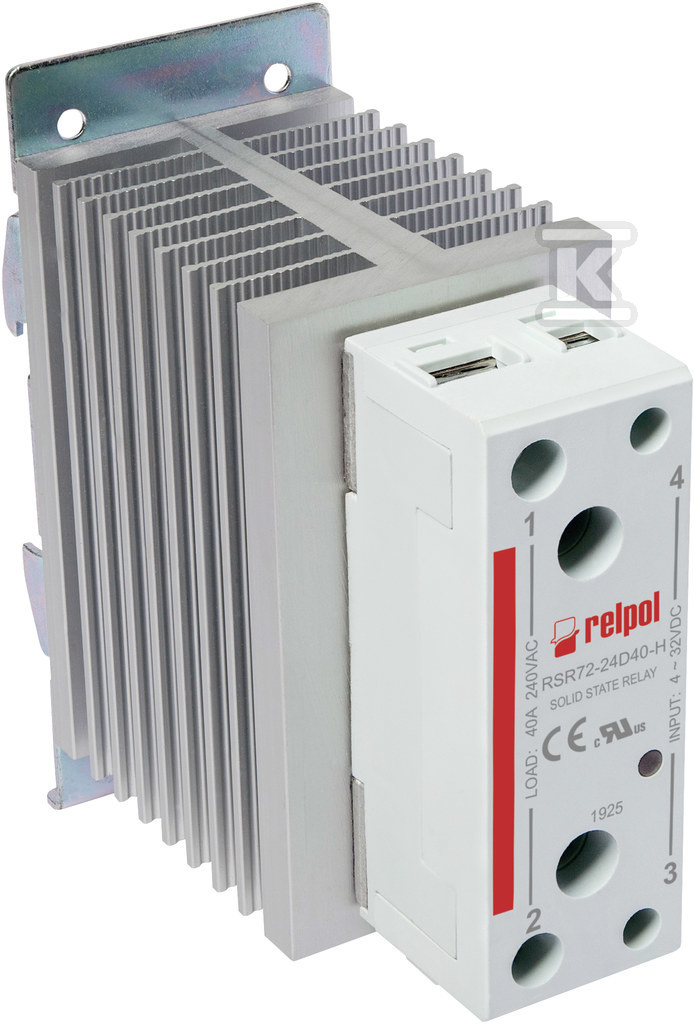
SSR relay RSR72-24D75-H RSR72-24D75-H 1-phase 2615988

Suggested products
TECHNICAL DATA
Sales unit dimensions and weight: 1 pcs
SSR relay RSR72-24D75-H RSR72-24D75-H 1-phase 2615988
Solid State Relay SSR – Reliable Load Control
The RSR72-24D75-H solid state relay is a robust solution for switching AC loads, especially where high switching frequency and long service life are required. Thanks to its design without moving parts, the relay eliminates the risk of arcing and electromagnetic interference, resulting in quiet operation and increased system reliability. This model, manufactured by the renowned company Relpol, is widely used in control cabinets, automation systems, and temperature and lighting control applications.
Characteristics and application
The RSR72-24D75-H is a single-phase solid state relay with a built-in heatsink, which provides effective heat dissipation and allows operation with loads up to 75A. Zero-crossing switching minimizes interference in the power grid and protects connected devices from overvoltage. The control input with a voltage of 4…32V DC allows for easy integration with various control systems. The use of a heatsink makes the relay ready to use immediately after installation – it does not require additional cooling elements.
Advantages and benefits
- High reliability: The absence of mechanical moving parts extends the relay's service life and minimizes the risk of failure.
- Quiet operation: The design without moving parts eliminates noise associated with switching.
- Efficient heat dissipation: The integrated heatsink ensures optimal cooling, allowing operation with larger loads.
- Safety: Zero-crossing switching reduces electromagnetic interference and protects connected devices.
- Versatility: A wide range of control input voltage (4…32V DC) simplifies integration with various control systems.
- Ready for mounting: The built-in heatsink eliminates the need for additional cooling and simplifies installation.
- Circuit isolation: The relay effectively isolates the control circuits from the output circuits, increasing system safety.