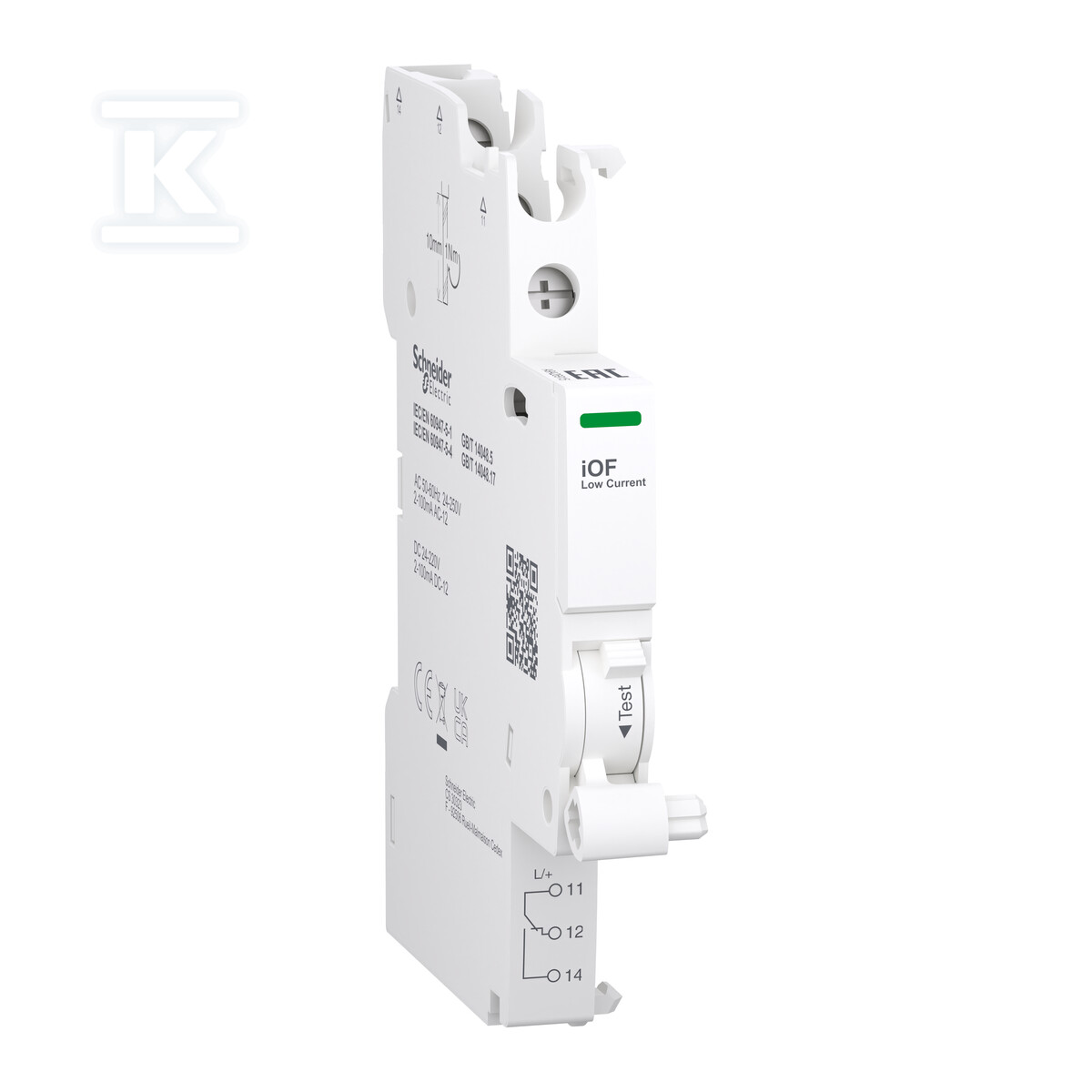
Auxiliary contact, Acti9, iOF 2-100 mA, 1CO, for low-current circuits, top connection A9A26915

- 23606482129164
- 3606482129160
Suggested products
TECHNICAL DATA
Sales unit dimensions and weight: 1 pcs
Auxiliary contact, Acti9, iOF 2-100 mA, 1CO, for low-current circuits, top connection A9A26915
Remote position signaling in Acti9 systems
The modular auxiliary contact from the Acti9 series, identified by the code iOF, is used for remote transmission of information regarding the status of a protective device, such as a miniature circuit breaker or a residual current device. This device does not perform a protective function for the main circuit, but rather acts as an indicator for controllers or building automation systems. Thanks to it, an installer can monitor whether a given circuit is closed or if a trip has occurred, without the need for visual inspection of every module in the distribution board. This is particularly useful in facilities where access to the distribution board is difficult or when integration with BMS systems is required.
Contact configuration and voltage range
A key feature of this module is the universal 1CO contact configuration (one changeover), which means it has one common contact, one normally open contact, and one normally closed contact. This design allows for flexible connection to various control circuits. The device supports a very wide range of operating voltages – from 24 V to 240 V AC and from 24 V to 220 V DC. This allows it to be used in both typical industrial and commercial installations powered by alternating current and in control systems based on direct current.
It should be noted that this contact operates in low-current circuits. The rated making current ranges from 2 mA to 100 mA. This means it is not suitable for direct control of large loads (e.g., motor contactors), but serves for logical signaling or controlling coils with low power consumption. This current is sufficient for most modern microprocessor control systems or position sensors.
Mounting and DIN rail compatibility
The product is characterized by a compact design with a width of only 9 mm (0.5 module), allowing for efficient use of space in modular distribution boards. Mounting is performed directly on the TH35 DIN rail, and the device is dedicated to working with miniature circuit breakers and residual current devices with overcurrent protection (Acti9 series). The maximum number of poles of the main device that can be connected to it is 4.
Wire connection is implemented via screw terminals located at the top of the module. This solution facilitates installation in densely packed distribution boards and ensures a secure electrical contact. The terminals allow for the connection of rigid copper wires with a cross-section from 1 mm² to 4 mm² (single) or two wires of 2.5 mm². For flexible wires, the permissible cross-section is from 0.5 mm² to 2.5 mm² (single) or two wires of 1.5 mm² when using ferrule connectors. The screw tightening torque is 1 N·m and requires the use of a PZ1 type screwdriver. Total dimensions are: width 9 mm, height 86 mm, and depth 73 mm. The housing color is standard white RAL 9003, ensuring an aesthetic match with the rest of the Acti9 equipment.
Operating conditions and safety
The device is designed to operate in pollution degree 3 conditions and has a tropicalization level 2, making it resistant to moisture and high temperatures in industrial or infrastructural environments (e.g., data centers, manufacturing plants). The operating temperature range is from -25°C to +70°C, and the storage range is from -40°C to +85°C. The IP20 protection rating protects against access to solid objects larger than 12 mm (e.g., fingers), but requires installation in a distribution board enclosure that meets the appropriate IP standards for the entire system.
Insulation parameters ensure a high level of safety: the rated insulation voltage Ui is 500 V, and the impulse withstand voltage Uimp reaches 4 kV. The product complies with strict EN/IEC 60947-5-1 and EN/IEC 60947-5-4 standards and holds certificates such as LCIE or KEMA. It does not have a residual current self-test function – this function depends on the connected main breaker – but it effectively fulfills its role as a reliable signaling element in electrical installation status monitoring systems.