Owners of large plots of land are eager to choose solutions that speed up and facilitate garden work. One of them is undoubtedly an irrigation system that supplies water from a well or rainwater tank to sprinklers or garden hoses . Its heart, however, is an efficient pump. Find out what type to choose for the system you are designing and what to consider in the decision-making process!
In this article you will learn:
- what technical parameters of garden pumps should you pay attention to when choosing them,
- what affects the efficiency of a garden pump,
- how to adapt a garden pump to the user's needs.
Check out the garden irrigation pumps at Onninen
It was already cheap. Watering the garden with water from the water supply network can turn out to be very expensive in the long run. On the other hand, we do not want our garden to turn into a dry, barren land, and due to climate change, we cannot always count on a sufficient level of irrigation from rainfall. A solution may be a pump powered, for example, from a deep well.
What types of irrigation pumps are there?
The first decision to make when choosing a garden pump is the type. The devices available on the market can be divided into several main types. First of all, you have at your disposal:
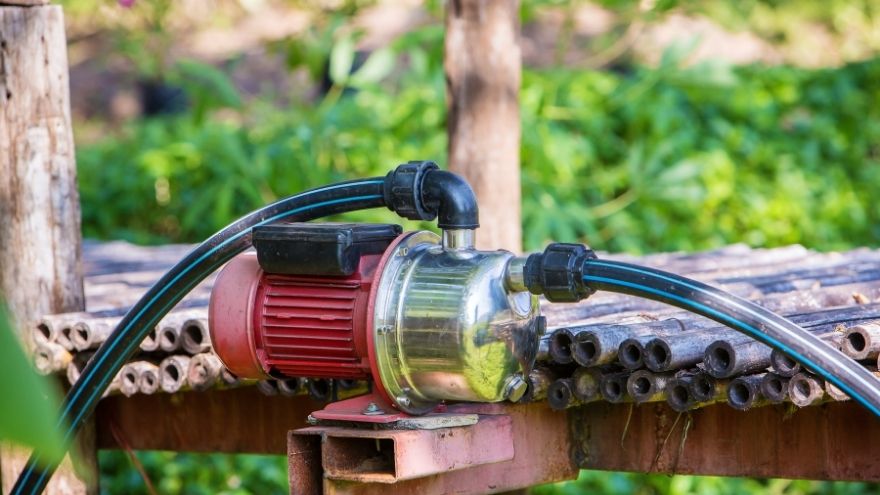
Self-priming pumps (surface)
However, there are reasons why self-priming pumps are not used in every irrigation system. Namely, they are limited by the suction height, which usually does not exceed 6-8 meters, and they also have a limited ability to pump water over long distances. For this reason, a surface pump should only be chosen when the water level is at this depth and close to the source. The amount of water pumped also depends on the capacity of the well. If there is a risk that it will not supply the right amount of water, you should consider choosing a different type of pump.
Submersible pumps
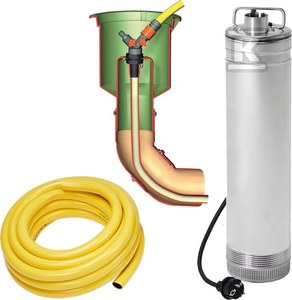
Submersible pumps are units consisting of, among other things, a hermetic motor adapted to work in water. They are mounted below the water surface, thanks to which they can draw water even from greater depths. Most models are protected against dry running - they are equipped with a float switch that automatically turns off the pump or electronic control systems. The corrosion-resistant housing, on the other hand, means that the devices are not damaged by difficult environmental conditions. The pumping height of submersible pumps varies depending on the model. There are devices available on the market that draw water to a depth of up to 45 m. A certain limitation of submersible pumps is the need to periodically check the seal of the motor itself.
Submersible pumps
Deep well pumps are mainly designed to draw water from boreholes and wells. The pumping height can range from less than 8 m to over 100 m (even 160 m). Their use is not limited by the depth of the well, but at most by the internal diameter of its casing pipes - at least 100 mm (the wider, the wider the choice of models). It is necessary to insert the pump unit into it to the appropriate depth (not to the bottom). In order to best adapt the device to the user's needs, it is first necessary to determine the depth range at which it will operate. This will facilitate the selection of a device with the appropriate capacity, but it must always be lower than the capacity of the well.
Deep well pumps are always installed below the water surface. Thanks to this, they will be properly cooled at all times. The only important parameter for these devices is the discharge height , which can be several dozen meters or more. It is worth remembering that the higher this value, the lower the pump efficiency. The suction height measured between the lowest water surface level and the pump axis is not important in this case.
Garden irrigation pumps
Which pump to choose for garden irrigation?
Knowing the most important types of pumps, we can try to make a short summary, depending on the water source:
- The traditional garden pump (surface) is designed to draw water from rainwater tanks or shallow wells, where the water level never drops below 6–8 meters. It comes in an electric version (less efficient and requiring access to a power source) and a combustion version (emitting pollutants and generating noise).
- A submersible pump can pump water to a height of several to as high as 45 m. Its advantages include ease of installation, high mobility and simplicity of use.
- A deep well pump is installed primarily in drilled wells and those where the water surface depth may fall below 20 meters from the target tank. The advantage of this solution is the economical mode of operation and the elimination of noise, because the device is located outside the house. The disadvantages, however, include the high cost of installing the pump and difficult access to it.
What to consider when selecting a pump for garden irrigation?
Once you have decided which type of pump to choose, you need to consider the specific parameters of this device. The key will of course be its efficiency, which – as you already know – depends on, among other things, the suction and discharge height.
Pump efficiency is a value that determines how much water will be pumped in a given unit of time. It is worth noting, however, that decisions should not be made solely on the basis of this parameter. Installing a pump with too high efficiency can damage it. This will happen when new water does not have time to collect in place of the pumped water. Therefore, it is necessary to take into account not only the level of medium consumption, but also the efficiency of the well.
It is good practice to verify this parameter. This is done by intensively pumping out water for at least an hour. This way you can find out how fast it collects in the well. If the process is very slow, you do not have to give up using this source for your garden irrigation system. Just choose a pump with a lower capacity and a suitably large hydrophore tank. The right capacity will make it a buffer with a supply of water for current needs, and the well will have time to fill up again during this time.
Check out the garden irrigation pumps at Onninen
 A much worse idea would be to install a high-capacity pump with a small water tank. Even if the well fills very quickly, any small loss of medium will require the pump to be started. Such frequent switching on and off of the device has a negative impact on its service life.
The choice of pump for a garden irrigation system should therefore be based on the curve presenting the level of decrease in the device's efficiency with the increase in suction or discharge height. Such equipment must operate in the range between its minimum and maximum efficiency. In an ideal scenario, the pump operates close to the point of highest efficiency, which reduces energy consumption and extends the device's operating time.
Garden pumps can be found in the Onninen offer
Regardless of which pump you choose for your garden irrigation system, you will find the necessary device in the assortment of our online wholesaler. Here you will find both deep well pumps, self-priming pumps and submersible pumps. We especially recommend the following models:
Wilo DRAIN 10-7 – a multi-purpose submersible drainage pump. It is characterized by a solid design and is equipped with a plastic impeller. It is perfect for pumping slightly polluted water, rainwater and drainage water.
Grundfos UNILIFT CC5-A1 – single-stage submersible drainage pump, used for pumping drainage water and grey sewage. It is flexible in terms of installation and use – it is suitable for both permanent and portable operation.
Flotec GARDENJET 750 – a self-priming hydrophore pump used to supply the building with clean utility water.
Wilo HWJ 202-EM-2 – a self-priming domestic water pump, supplying the building with clean water. It is characterized by a 20-liter tank, noiseless operation and an engine suitable for continuous operation.
Wilo-Sub TWU 4-0414-C EM – multistage submersible pump, suitable for both horizontal and vertical installation.
Grundfos SCALA1 – a versatile, self-priming pump designed to increase pressure in the home system, as well as for garden irrigation. It is characterized by a compact design and universal use.
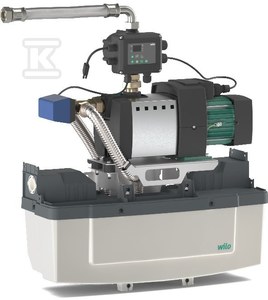 It is also worth paying attention to rainwater units, which are a novelty on the market. They allow water to be pumped from a rainwater tank, which in the event of shortages is refilled from the water supply. Such a system comprehensively solves the problem of using rainwater for garden irrigation. An example of an efficient unit is the Wilo RAIN1-24 EM model. It is equipped with an automatic water supply function from the water supply network, a self-priming pump, dry-running protection and an operation and failure signaling system.
Thanks to Onninen's wide range of products, you can easily choose a solution that is ideally suited to the specifics of the building you manage or the needs of your customers.