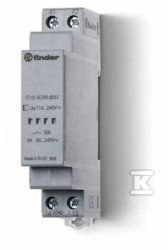
SSR relay with heatsink for DIN rail 30A, instantaneous switching, 230V AC control 77.31.8.230.8051
Suggested products
TECHNICAL DATA
Sales unit dimensions and weight: 1 pcs
SSR relay with heatsink for DIN rail 30A, instantaneous switching, 230V AC control 77.31.8.230.8051
Contactless Control of AC Circuits
This modular solid-state relay (SSR) from FINDER's 77 series is a solution dedicated to applications requiring fast and reliable switching of resistive loads. The device combines a compact DIN-rail housing with a built-in heatsink, eliminating the need for additional cooling elements at currents up to 30 A. This provides the installer with space savings in the distribution board, while the end-user benefits from silent operation without moving parts that could suffer mechanical wear.
A key feature of this model is instantaneous switching, meaning the semiconductor contact reacts immediately upon the appearance of the control voltage, regardless of the phase of the mains voltage. This is critical in applications where precise reaction time is essential or when switching inductive loads, although in this case the device is optimized for AC-1 (resistive) loads. The control voltage is 230 V AC (for 50 and 60 Hz networks), allowing direct connection to standard control outputs in industrial automation or building management systems without the need for additional intermediary relays.
Applications and Operational Benefits
The device is ideally suited for electric heating systems, ventilation, or lighting, where frequent switching of high currents is required. The absence of sparking during switching makes it safe for use in explosive environments (with appropriate enclosure protection) and prevents interference with other nearby electronic devices. The built-in heatsink ensures dissipation of heat generated during current flow, enabling long-term operation at full load without risk of module overheating.
For the installer, mounting ergonomics are also important:
- Power and load terminals are located on opposite sides of the housing – this configuration simplifies wiring and improves schematic readability in the distribution board.
- DIN-rail mounting (35 mm) in accordance with EN 60715 allows quick installation in standard distribution enclosures.
- IP20 protection rating protects against accidental contact with live parts but requires installation in a covered enclosure or distribution cabinet.
It is worth noting that the maximum switching current can reach 520 A (for a short duration), providing a significant safety margin when starting devices with high inrush currents, although the device operates stably at a nominal 30 A. The operating temperature range from -20°C to +80°C makes it a universal component for both indoor installations and those located in unheated technical rooms.
Operating Conditions and Key Electrical Characteristics
When designing installations, it is important to remember the specific operating characteristics of this relay: it does not feature zero-crossing synchronization. This means that switching occurs immediately upon receiving the control signal, generating higher electromagnetic interference compared to zero-crossing synchronized models. Therefore, the device is best suited for applications where the priority is the speed of the control system response over minimizing radio frequency noise – for example, in simple circuits for switching heaters or halogen lamps.
In practice, this allows operation with a rated current of 30 A for AC-1 resistive loads at a mains voltage up to 400 V AC. Control is performed directly with 230 V AC (50/60 Hz), simplifying connection diagrams by eliminating the need for additional auxiliary voltage sources. The device handles a single-phase circuit and is characterized by resistance to current surges up to 520 A during short inrush pulses. The permissible ambient temperature range extends from -20°C to +80°C, allowing installation even in unheated technical rooms without risk of degradation of the module's electronic parameters.
The device is intended for industrial and installation applications compliant with standards for solid-state relays. Due to the lack of zero-crossing switching functionality, it should not be used in applications where minimizing electromagnetic interference generated at the moment of switching is critical – in such cases, zero-crossing synchronized models are a better choice. However, for typical heating or lighting loads