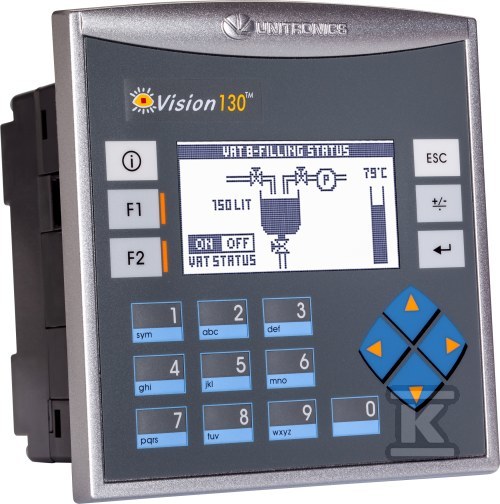
PLC controller with 2.4" HMI panel OPLC: 20 DI, 2 D/A, 16 DO V130-33-T38
Suggested products
TECHNICAL DATA
Sales unit dimensions and weight: 1 pcs
PLC controller with 2.4" HMI panel OPLC: 20 DI, 2 D/A, 16 DO V130-33-T38
PLC Controller with HMI Panel – a Compact Solution for Automation
This PLC controller with a built-in 2.4-inch HMI panel combines control and visualization functionality in one device. It is an ideal solution for a wide range of industrial applications where reliability, flexibility, and ease of use are required. Model V130-33-T38 offers 20 digital inputs (DI), 2 digital-analog inputs, and 16 transistor outputs (TO), allowing for the control of various processes and devices.
Functionality and Capabilities
This controller is designed to operate in demanding industrial conditions. Communication via RS232/485 port (Modbus Master/Slave protocol) enables integration with other devices and automation systems. Additionally, there is an option to expand with a CANbus or Ethernet interface, which increases its versatility. The built-in microSD card slot (up to 32 GB) allows for easy storage of data, programs, and graphic files.
Thanks to the integrated HMI panel, the operator has direct access to process information and the ability to monitor and control it. The panel allows displaying data in a graphical form, which facilitates interpretation and decision-making.
Applications and Benefits
This controller finds application in many areas of industry, such as:
- Machine and device control: precise control of production processes, assembly lines, or transport devices.
- Building automation: control of lighting, heating, ventilation, and air conditioning.
- Monitoring systems: collection and analysis of data from sensors and displaying them on the HMI panel.
- Technological processes: control of parameters of production processes, such as temperature, pressure, or flow.
Thanks to its compact size and the possibility of panel mounting (IP65) or DIN rail mounting (IP20), the controller can be easily integrated with the existing infrastructure. Ladder programming provides flexibility and ease of creating applications tailored to individual needs. The built-in real-time clock and battery-backed memory retention (up to 7 years) guarantee reliable system operation even in the event of a power failure.